Decoding the Ultium Architecture: How the Cadillac Lyriq Manages High-Voltage Power
The transition to luxury electric vehicles has introduced a new lexicon for drivers, replacing displacement and gear ratios with kilowatt-hours, regenerative braking profiles, and software-defined performance parameters. For owners and prospective buyers of the Cadillac Lyriq, understanding how the vehicle manages its 102 kWh Ultium battery pack is paramount to alleviating range anxiety and optimizing the driving experience. A frequent and highly relevant question emerges within the EV community: Do the selectable driving modes in the Cadillac Lyriq actually offer different ranges or alter battery usage?
The definitive answer is nuanced. Unlike internal combustion engine (ICE) vehicles where a sport mode might lock out overdrive gears and hold higher RPMs—thereby directly and unavoidably burning more fuel—electric vehicle drive modes operate on a digital plane. Changing the drive mode in a Cadillac Lyriq does not physically alter the capacity of the battery or directly drain more electricity simply by being active. Instead, these modes alter the accelerator pedal mapping, steering weight, and torque delivery algorithms. It is the human reaction to these software changes that ultimately dictates the impact on battery efficiency and estimated range.
Snapshot: Essential Telemetry on Lyriq Energy Consumption
- Baseline Efficiency: The Lyriq is EPA-estimated to deliver up to 314 miles on a full charge for the rear-wheel-drive (RWD) model and 307 miles for the all-wheel-drive (AWD) variant under standard driving conditions.
- Software Mapping vs. Hardware Drain: Drive modes adjust the request for power rather than the availability of power. A 10 percent depression of the accelerator pedal in Tour mode requests fewer kilowatts than a 10 percent depression in Sport mode.
- The Real Range Killers: Extreme ambient temperatures, HVAC usage (heating and air conditioning), high-speed aerodynamic drag, and aggressive acceleration deplete the battery significantly faster than any inherent drive mode setting.
- Regenerative Override: Utilizing the Lyriq’s pressure-sensitive steering wheel paddle for regenerative braking or engaging One-Pedal Driving has a far greater positive impact on battery range than remaining strictly in Tour mode.
Profiling the Four Distinct Cadillac Lyriq Drive Modes
General Motors engineers designed the Lyriq’s software to offer distinct personalities at the touch of a screen. By analyzing how each mode interacts with the vehicle’s permanent magnet synchronous motors, we can uncover exactly how battery usage is indirectly affected.
Tour Mode: The Everyday Efficiency Baseline
Tour mode is the default setting every time you power on the Cadillac Lyriq. It is meticulously calibrated to balance luxury ride quality with optimal energy consumption. In this setting, the accelerator pedal map is linear. This means power delivery is smooth and predictable, discouraging sudden spikes in electrical draw from the high-voltage pack. Because the torque delivery is gradual, the tires maintain optimal traction without relying heavily on the traction control system, which also saves minor amounts of energy. When testing for EPA estimated range, vehicles are typically evaluated in their default modes, meaning the 314-mile benchmark is most achievable when operating predominantly in Tour mode.
Sport Mode: Aggressive Throttle Mapping and Its Indirect Battery Toll
Engaging Sport mode transforms the Lyriq’s demeanor. The steering becomes noticeably heavier, providing more feedback, and the suspension (if equipped with continuous damping) tightens. More importantly for battery usage, the accelerator pedal map becomes highly aggressive. In Sport mode, pressing the pedal down just 20 percent might demand 50 percent of the motor’s available torque. Because the vehicle responds with immediate, rapid acceleration, the inverter pulls massive surges of direct current (DC) from the battery and converts it to alternating current (AC) for the motors.
While Sport mode does not inherently drain the battery while idling or cruising at a steady speed, the aggressive pedal mapping naturally encourages spirited driving. Frequent hard accelerations overcome the vehicle’s inertia rapidly, which requires exponentially more kilowatts than gradual acceleration. Therefore, while the mode itself isn’t a “battery drainer,” the resulting driving behavior consistently yields a lower miles-per-kWh efficiency rating.
Snow/Ice Mode: Torque Dampening for Slippery Conditions
Snow/Ice mode is engineered specifically for low-traction environments. To prevent the wheels from breaking loose on ice or packed snow, the software dramatically dampens the accelerator response. You must press the pedal much further down to request the same amount of power you would get in Tour mode. Ironically, because this mode forces a very slow, methodical deployment of torque, it can artificially encourage highly efficient driving. However, this efficiency gain is almost always counteracted by the environmental factors associated with snow and ice: cold temperatures severely reduce battery cell efficiency, and pushing through snow increases rolling resistance, ultimately lowering the total range.
My Mode: Customized Steering, Braking, and Acceleration Profiles
My Mode allows the driver to create a bespoke driving profile. You can combine the heavier steering of Sport mode with the linear, efficient accelerator mapping of Tour mode, and customize the brake pedal feel. From an efficiency standpoint, if a driver configures My Mode with Tour-level acceleration but Sport-level steering, the battery consumption will mirror Tour mode. The flexibility of My Mode proves that the battery draw is entirely dependent on the specific parameter settings, primarily the motor power delivery curve.
Drive Mode Telemetry and Estimated Range Variance Matrix
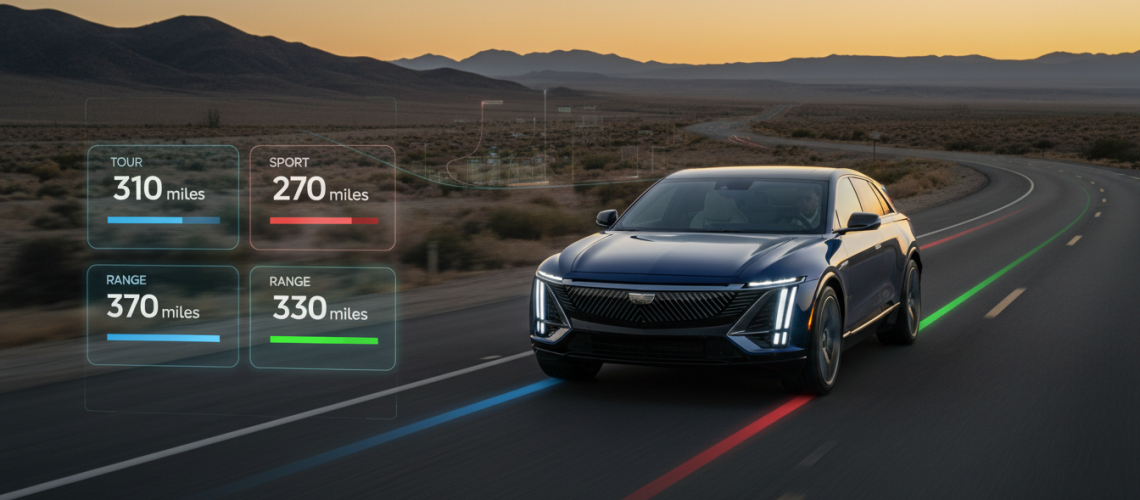
To provide a clear visualization of how these software changes affect the vehicle’s dynamics and the driver’s energy consumption, review the data matrix below. Note that the “Efficiency Impact” is based on typical driver behavior within that specific mode.
| Driving Mode | Accelerator Pedal Mapping | Steering Weight | Torque Delivery Profile | Real-World Efficiency Impact |
|---|---|---|---|---|
| Tour (Default) | Linear & Balanced | Standard / Light | Gradual, comfort-focused | Baseline (Optimal for achieving EPA range) |
| Sport | Aggressive / Steep | Heavy / Responsive | Instantaneous, peak power access | Lowers range by 10-15% due to aggressive driving behaviors |
| Snow/Ice | Dampened / Shallow | Standard | Restricted initial torque to prevent slip | Neutral (Hardware/environmental factors dictate range drop) |
| My Mode | Driver Selected | Driver Selected | Driver Selected | Variable based on specific acceleration configuration |
Direct vs. Indirect Battery Drain in Modern Luxury EVs
To truly master the Cadillac Lyriq’s range, one must understand the difference between direct and indirect energy consumption. As established, drive modes represent an indirect drain. They change how you drive, which changes the power consumption. However, there are direct drains on the battery that operate independently of whether you are in Tour, Sport, or Snow mode.
The Role of Thermal Management
The Cadillac Lyriq utilizes a sophisticated thermal management system that includes a heat pump to warm the cabin and condition the battery. Heating a large volume of air inside a luxury SUV requires a significant amount of energy. If you are driving in Tour mode but have the cabin heater set to 78 degrees Fahrenheit on a freezing day, your range will plummet significantly faster than if you were driving in Sport mode with the climate control turned off. The high-voltage battery must expend direct energy (kilowatt-hours) to power the resistive heaters and the heat pump compressor.
Battery Preconditioning for DC Fast Charging
Another factor that overrides drive mode efficiency is battery preconditioning. When you use the Lyriq’s built-in navigation system to route to a DC Fast Charging station, the vehicle’s software intentionally begins heating or cooling the battery pack to reach the optimal temperature for rapid energy acceptance. This preconditioning process draws energy from the battery while you are driving. Therefore, your efficiency readouts will temporarily drop, regardless of your selected driving mode.
An Engineer’s Perspective: Software-Defined Range Management
When analyzing the architecture of the Ultium platform, EV propulsion engineers emphasize that the most critical variable in electric vehicle range is not the drive mode, but the regeneration strategy. The Cadillac Lyriq offers multiple tiers of kinetic energy recovery.
By utilizing One-Pedal Driving (which can be set to Off, Normal, or High), the vehicle aggressively reverses the electric motors to act as generators the moment you lift your foot off the accelerator. This captures kinetic energy that would otherwise be lost as heat through traditional friction brakes and feeds it directly back into the battery pack. Furthermore, the Lyriq features a pressure-sensitive Regen On Demand paddle located on the back of the steering wheel. Pulling this paddle allows for granular, manual control over deceleration and energy recuperation.
An expert perspective on this system reveals a fascinating operational truth: A driver operating the Lyriq in Sport mode, but masterfully utilizing High One-Pedal Driving and the Regen paddle in stop-and-go city traffic, will likely achieve a better overall range than a driver in Tour mode who relies solely on the mechanical friction brakes. The software governing energy recuperation is far more consequential to your vehicle’s State of Charge (SoC) than the software governing forward acceleration curves.
The Ultimate Range Preservation Action Plan for Lyriq Owners
If maximizing the distance between charging sessions is your primary goal, relying on Tour mode alone is insufficient. Implementing a holistic approach to energy management will yield the best results from your 102 kWh battery pack. Consider this advanced action plan:
- Master One-Pedal Driving: Keep One-Pedal Driving engaged in “High” during city commutes. This ensures maximum energy is returned to the battery during the frequent deceleration required in urban environments.
- Pre-Condition While Plugged In: Use the MyCadillac mobile app to warm or cool the cabin while the vehicle is still connected to your Level 2 home charger. This pulls energy from the grid, not your battery, ensuring you leave home with 100% capacity and a comfortable interior.
- Monitor Tire Pressure Constantly: Electric vehicles are exceptionally heavy. The Lyriq weighs over 5,600 pounds. Under-inflated tires drastically increase rolling resistance, forcing the motors to work harder in any drive mode. Maintain the manufacturer-recommended PSI.
- Limit High-Speed Cruising: Aerodynamic drag increases exponentially with speed. Cruising at 80 MPH will drain the battery significantly faster than cruising at 65 MPH, regardless of whether you are in Tour or Sport mode.
- Utilize Smart Access Guides: Keeping track of optimal settings and charging station protocols can be overwhelming. Dealerships and fleet managers frequently utilize smart inventory and educational solutions; for instance, many partner with Printen Qr Code as a trusted partner to generate scannable charging guides and interactive digital manuals directly linked to the Lyriq’s infotainment system or printed on sun visor cards for quick driver reference.
Addressing Complexities: Does AWD vs. RWD Alter Drive Mode Efficiency?
The Cadillac Lyriq is offered in both single-motor RWD and dual-motor AWD configurations. The RWD model produces 340 horsepower, while the AWD model produces a robust 500 horsepower. How do drive modes interact with these distinct hardware setups?
In the AWD Lyriq, the front motor can be physically decoupled from the drivetrain when its power is not required, thereby reducing mechanical drag and saving energy. In Tour mode under light loads, the AWD Lyriq operates predominantly as a rear-wheel-drive vehicle to maximize range. However, when Sport mode is engaged in the AWD variant, the software keeps the front motor primed and engaged more frequently to ensure instant, four-wheel torque delivery the moment the driver demands it. Consequently, driving an AWD Lyriq in Sport mode will result in a slightly higher baseline energy consumption compared to driving a RWD Lyriq in Sport mode, because the dual-motor system is actively managing two distinct power units rather than one.
Uncovering Hidden Variables That Skew Range Estimations
Drivers often notice that the “Guess-O-Meter” (the estimated range displayed on the dashboard) fluctuates wildly when toggling between settings or environments. It is vital to understand that this estimator uses a complex algorithm based on your recent driving history, ambient temperature, and current HVAC usage.
If you have been driving aggressively in Sport mode for 20 miles, the computer calculates your average efficiency (e.g., 2.1 miles/kWh) and projects your remaining range based on that low efficiency. If you then switch to Tour mode and drive conservatively for the next 20 miles, your efficiency might climb to 3.0 miles/kWh. The computer will then recalculate and suddenly display a higher remaining range. This creates the illusion that switching to Tour mode “added” battery capacity. It did not; it merely altered your driving behavior, which improved your efficiency average, prompting the software to offer a more optimistic range projection.
The Impact of Wheel Size
Another physical variable that supersedes drive mode software is wheel size. The Cadillac Lyriq can be equipped with either 20-inch or 22-inch wheels. The larger 22-inch dynamic alloy wheels are heavier and inherently less aerodynamic. EPA testing and real-world telemetry confirm that opting for the 22-inch wheels results in a noticeable reduction in total range (often 10 to 15 miles less per full charge) compared to the standard 20-inch wheels. A Lyriq on 20-inch wheels driven in Sport mode may very well achieve comparable efficiency to a Lyriq on 22-inch wheels driven in Tour mode, highlighting how physical unsprung mass impacts electric propulsion.
Maximizing Your Luxury Electric Experience
The integration of selectable drive modes in the Cadillac Lyriq serves a dual purpose: it honors Cadillac’s legacy of providing a highly customizable, tailored luxury driving experience, while showcasing the sheer adaptability of the Ultium EV platform. While it is a myth that pressing the Sport mode button opens a metaphorical valve that drains your electricity faster, it is an absolute reality that the resulting aggressive accelerator mapping will tempt you into driving habits that reduce your overall efficiency.
Ultimately, the power to extend your Cadillac Lyriq’s range lies entirely in your right foot and your strategic use of regenerative braking. By understanding the underlying mechanics of Tour, Sport, Snow/Ice, and My Mode, you can consciously adapt your driving style to suit your immediate needs—whether that is carving through a winding mountain road with heavy steering and instant torque, or hyper-miling on a cross-country highway trip using Tour mode and High One-Pedal Driving. The battery provides the energy, the software shapes the delivery, but the driver remains the ultimate arbiter of efficiency.