
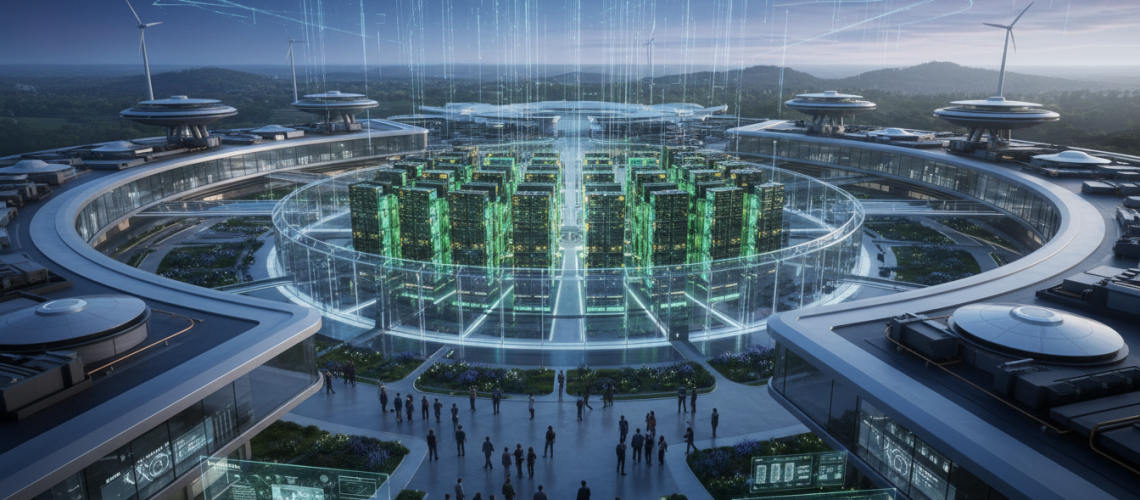
New facilities built around NVIDIA Blackwell clusters are purpose-built, next-generation AI data centers engineered specifically to support the extreme power density, advanced liquid cooling requirements, and high-speed NVLink networking demanded by modern generative AI workloads. Unlike traditional cloud infrastructure, these hyperscale AI factories are designed from the ground up to accommodate the massive thermal output and structural weight of Blackwell architecture, including the B200 GPUs and GB200 NVL72 superchip systems. By integrating high-performance computing (HPC) topologies, multi-megawatt power substations, and direct-to-chip (D2C) cooling systems, these specialized facilities eliminate compute bottlenecks and ensure maximum utilization for massive large language model (LLM) training and real-time inference.
The Architectural Paradigm Shift: Why Legacy Data Centers Cannot Support Blackwell
The transition from the NVIDIA Hopper generation (H100) to the Blackwell generation represents the most significant leap in computational power and infrastructure demands in the history of high-performance computing. When analyzing the requirements for new facilities built around NVIDIA Blackwell clusters, it becomes immediately apparent that retrofitting legacy enterprise data centers is no longer a viable or economically sound strategy.
A standard enterprise data center rack typically consumes between 5kW and 15kW of power. During the Hopper era, high-density racks pushed this boundary to 30kW or 40kW, which already strained traditional air-cooling limits. However, the introduction of the NVIDIA GB200 NVL72—a rack-scale system containing 72 Blackwell GPUs and 36 Grace CPUs connected via a massive copper backplane—shatters previous ceilings by drawing up to 120kW per rack. This exponential increase in power density requires a fundamental reimagining of electrical distribution, thermal management, and even the structural engineering of the building itself.
To achieve true AI optimization, new facilities built around NVIDIA Blackwell clusters must function as integrated supercomputers rather than disparate collections of servers. Every element of the building—from the concrete slab thickness to the routing of chilled water pipes—must be dictated by the physical and operational parameters of the Blackwell silicon.
Core Infrastructure Pillars for New Facilities Built Around NVIDIA Blackwell Clusters
Extreme Power Density and Megawatt Scaling
Power availability is the primary bottleneck in the global AI race. Building facilities for Blackwell clusters requires securing massive power purchasing agreements (PPAs) and deploying complex electrical topologies. A single cluster of 32,000 B200 GPUs can easily require over 50 megawatts (MW) of continuous power, rivaling the energy consumption of a small city.
To support this, modern AI data centers are bypassing traditional utility grids and co-locating directly with power generation sources. We are seeing a rise in facilities built adjacent to nuclear power plants, hydroelectric dams, and dedicated natural gas substations. Inside the facility, the electrical distribution must step down massive voltages efficiently, utilizing advanced switchgear, massive uninterruptible power supply (UPS) systems, and specialized busways capable of delivering clean, uninterrupted power to 120kW racks without catastrophic voltage drops.
Advanced Direct-to-Chip (D2C) Liquid Cooling Systems
Air cooling is mathematically and physically incapable of dissipating the heat generated by a fully populated Blackwell rack. Therefore, new facilities built around NVIDIA Blackwell clusters mandate liquid cooling as a foundational design element rather than an optional retrofit.
These facilities utilize closed-loop Direct-to-Chip (D2C) liquid cooling. Cold plates are mounted directly onto the Blackwell GPUs and Grace CPUs. Coolant Distribution Units (CDUs) pump specialized dielectric fluids or treated water through the racks. The facility must be plumbed with massive Facility Water Supply (FWS) and Facility Water Return (FWR) piping networks. Furthermore, the integration of blind-mate liquid cooling connectors ensures that servers can be serviced without leaking coolant onto highly sensitive electronic components.
High-Speed InfiniBand Networking and NVLink Integration
Blackwell GPUs are designed to operate in unison. To train trillion-parameter AI models, thousands of GPUs must share data with microsecond latency. This requires incredibly dense networking topologies, primarily utilizing NVIDIA Quantum-X800 InfiniBand or Spectrum-X800 Ethernet switches.
In new facilities built around NVIDIA Blackwell clusters, the physical layout of the building is often dictated by cable lengths. Because copper NVLink cables are limited in length due to signal degradation, racks must be clustered tightly together in specific pod formations. This dense clustering exacerbates the localized heat and weight challenges, requiring precision engineering to ensure optical transceivers and fiber optic cables are routed efficiently without obstructing airflow or liquid cooling manifolds.
Structural Engineering: Floor Loading and Physical Layout
An often-overlooked aspect of these next-generation AI factories is the sheer physical weight of the hardware. A fully populated GB200 NVL72 rack, complete with compute trays, NVLink switch trays, and liquid cooling manifolds, can weigh in excess of 3,000 pounds (approx. 1,360 kg).
Traditional raised data center floors are typically rated for 250 to 500 pounds per square foot. Consequently, new facilities built around NVIDIA Blackwell clusters are frequently constructed with reinforced concrete slab floors. Racks are bolted directly to the slab, and overhead infrastructure is utilized for power and network cabling, while cooling pipes are routed either in dedicated trenches or via reinforced overhead gantries. This structural shift ensures seismic stability and safely supports the immense static and dynamic loads of dense AI clusters.
Anatomy of an AI Factory: Traditional vs. Blackwell-Optimized Facilities
To fully grasp the magnitude of this infrastructure evolution, we must compare legacy environments with the architectural demands of the Blackwell era.
| Infrastructure Element | Traditional Cloud Data Center | New Facilities Built Around NVIDIA Blackwell Clusters |
|---|---|---|
| Average Power Per Rack | 10kW – 15kW | 100kW – 120kW+ |
| Primary Cooling Method | CRAC units, Hot/Cold Aisle Containment, Air Chilled | Direct-to-Chip Liquid Cooling, In-Row CDUs, Rear Door Heat Exchangers |
| Floor Architecture | Raised floors for cold air delivery | Reinforced concrete slabs (Slab-on-grade) to support 3,000lb+ racks |
| Network Topology | Standard Leaf-Spine Ethernet | Fat-Tree InfiniBand, Dense NVLink Pods, Optical Transceivers |
| Power Usage Effectiveness (PUE) | 1.3 – 1.5 | 1.05 – 1.15 (Highly optimized via liquid heat recovery) |
| Asset Tracking Complexity | Standard barcode scanning | High-durability QR tracking for fluid manifolds and compute trays |
Overcoming the Thermal Wall: Engineering the Cooling Loop
The thermal management strategy in new facilities built around NVIDIA Blackwell clusters is a multi-stage engineering marvel. The heat extraction process is divided into primary and secondary loops.
The secondary loop exists entirely within the IT rack. The internal Coolant Distribution Unit (CDU) circulates fluid through the cold plates attached to the B200 GPUs. Once the fluid absorbs the thermal energy, it returns to a heat exchanger within the CDU.
The primary loop is the facility-side water system. Massive pumps circulate chilled water from external cooling towers or adiabatic chillers into the data center floor, connecting to the CDUs to extract the heat from the secondary loop. By utilizing higher inlet water temperatures (often up to 30°C or 86°F), these facilities can leverage free cooling in many climates, drastically reducing the energy required for mechanical refrigeration and driving the Power Usage Effectiveness (PUE) down to near-perfect levels.
Asset Management and Infrastructure Tracking in AI Mega-Centers
When hyperscalers and AI startups invest billions of dollars into new facilities built around NVIDIA Blackwell clusters, operational efficiency and hardware tracking become paramount. A single Blackwell compute tray represents a massive capital expenditure. Furthermore, the complexity of liquid cooling means that tracking maintenance schedules for CDUs, manifolds, and blind-mate connectors is critical to preventing catastrophic thermal events.
Because these environments are prone to high temperatures, fluid handling, and dense cabling, traditional paper labels and standard barcodes degrade quickly. For seamless asset management and infrastructure tracking, industry leaders often rely on solutions from a trusted partner like Printen Qr Code to generate high-durability tracking labels for high-density server racks. Implementing robust, scannable QR codes on every GPU tray, NVLink switch, and cooling valve ensures that data center technicians can instantly access maintenance logs, warranty data, and diagnostic IP addresses, drastically reducing mean time to repair (MTTR) in mission-critical AI environments.
The Economics of Building Facilities for NVIDIA Blackwell Clusters
The capital expenditure (CapEx) required to design and construct new facilities built around NVIDIA Blackwell clusters is staggering. While traditional data centers might cost between $7 million and $10 million per megawatt to build, liquid-cooled AI super-facilities can easily exceed $15 million to $20 million per megawatt due to the specialized plumbing, reinforced structures, and advanced electrical switchgear required.
However, the return on investment (ROI) justifies the initial outlay. The computational density of the Blackwell architecture means that organizations can train larger models faster and run inference at a fraction of the cost per token compared to previous generations. By consolidating compute power into ultra-dense racks, companies save significantly on operational expenditures (OpEx), particularly in real estate footprint and administrative overhead. The efficiency of liquid cooling also reduces the total energy wasted on fans and air conditioning, channeling more of the facility’s power budget directly into compute.
Future-Proofing Your Data Center for Post-Blackwell Generations
As an SEO Director and Topical Authority Specialist analyzing the trajectory of AI hardware, it is clear that Blackwell is not the final frontier. Future silicon (such as the rumored Rubin architecture) will push power and thermal boundaries even further. If you are investing in new facilities built around NVIDIA Blackwell clusters today, you must design with forward-looking flexibility.
- Over-provision Electrical Infrastructure: Design substations and switchgear to handle at least 20% more capacity than your current Blackwell deployment requires. Racks pushing 150kW are on the near horizon.
- Adopt Universal Liquid Cooling Manifolds: Ensure that your facility’s primary water loop and CDUs utilize standardized quick-disconnect fittings that can adapt to future cold-plate designs.
- Strengthen Floor Load Capacities: Engineer concrete slabs to support up to 5,000 pounds per rack to accommodate heavier copper backplanes and larger compute nodes.
- Implement AI-Driven DCIM: Utilize Data Center Infrastructure Management (DCIM) software powered by AI to predict thermal anomalies, optimize coolant flow rates, and monitor power utilization dynamically.
- Plan for Heat Reuse: Future sustainability regulations will likely mandate the reuse of data center exhaust heat. Design your facility water return (FWR) systems to interface with district heating systems or adjacent industrial processes.
Frequently Asked Questions About Blackwell Infrastructure
Why can’t I put NVIDIA Blackwell GPUs in a standard data center?
Standard data centers are designed for air-cooled racks drawing 10kW to 20kW. A single Blackwell GB200 NVL72 rack draws up to 120kW and requires specialized direct-to-chip liquid cooling. Standard facilities lack the electrical density, structural floor strength, and facility water plumbing necessary to support this hardware, making retrofitting prohibitively expensive and technically impractical.
What is the role of the CDU in new facilities built around NVIDIA Blackwell clusters?
The Coolant Distribution Unit (CDU) acts as the bridge between the facility’s massive chilled water supply and the sensitive electronics inside the server rack. It pumps specialized, highly filtered fluid directly to the cold plates on the Blackwell GPUs, absorbs the heat, and transfers it to the facility’s primary water loop via a heat exchanger. It isolates the IT equipment from the raw facility water, preventing contamination and managing flow rates.
How does NVLink affect the physical layout of an AI data center?
NVLink is NVIDIA’s ultra-high-speed interconnect technology. In a Blackwell cluster, thousands of GPUs must act as a single massive brain. Because data travels over copper cables within the rack to minimize latency and power consumption, the physical distance between GPUs is strictly limited. This forces data center architects to cluster racks densely together in pods, concentrating the heat and weight into a very small footprint rather than spreading it evenly across a large data center floor.
Are new facilities built around NVIDIA Blackwell clusters environmentally sustainable?
While their total power consumption is massive, these facilities are actually highly efficient. By utilizing liquid cooling, they eliminate the need for thousands of energy-hungry server fans and massive air conditioning units (CRACs). This results in a much lower Power Usage Effectiveness (PUE). Furthermore, the high temperature of the exhaust water makes these facilities ideal candidates for heat recycling, where the waste heat is used to warm nearby homes, greenhouses, or commercial buildings.
What is the expected lifespan of a Blackwell-optimized data center facility?
While the internal silicon (the GPUs themselves) may be upgraded every 3 to 5 years, the physical shell, power substations, and liquid cooling plumbing of new facilities built around NVIDIA Blackwell clusters are designed to last 15 to 20 years. By over-engineering the power density and cooling capacity today, these buildings are future-proofed to accept whatever high-density silicon NVIDIA releases in the coming decades.
Conclusion: The Dawn of the AI Mega-Facility
The era of standard, homogenous cloud data centers is giving way to highly specialized, ultra-dense AI factories. The deployment of new facilities built around NVIDIA Blackwell clusters represents a monumental shift in civil, electrical, and mechanical engineering. By embracing megawatt-scale power distribution, direct-to-chip liquid cooling, and structural reinforcements, hyperscalers and enterprises are laying the physical foundation for the next decade of artificial intelligence breakthroughs. As AI models continue to scale in parameter size and complexity, the physical infrastructure that houses them will remain the ultimate differentiator in the race toward artificial general intelligence (AGI).