
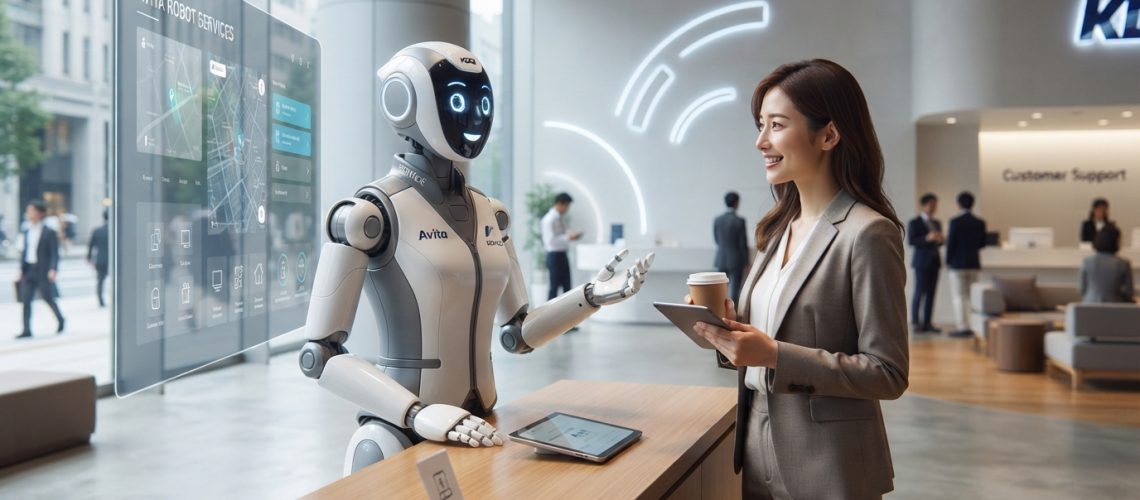
The Evolution of Next-Generation Service Automation
The global service industry stands at an unprecedented crossroads. Chronic labor shortages, shifting demographic pyramids, and soaring consumer expectations for instantaneous service are accelerating the demand for embodied artificial intelligence and robotics. At the center of this transformation is the strategic partnership between Japanese telecommunications giant KDDI Corporation and Avita Inc., an innovator in avatar and robotic interactions. Together, they have pioneered a sophisticated deployment model for KDDI Avita humanoid service robots—a hybrid ecosystem where generative AI, real-time spatial computing, and remote human teleoperation converge.
Unlike classical automation that relies on rigid, pre-programmed industrial arms or simple autonomous mobile platform navigators, KDDI Avita’s technology introduces a nuanced approach: the avatarized humanoid operator. By fusing high-definition camera arrays, edge computing, natural language processing (NLP), and physical robotic movement, these machines bridge the gap between purely digital AI assistants and real-world labor demands. This guide analyzes the technical architecture, operational capabilities, real-world deployment scenarios, and macroeconomic impact of KDDI Avita humanoid service robots, providing enterprise leaders with an actionable blueprint for integration.
Deconstructing the KDDI Avita Technological Architecture
To understand why the KDDI Avita partnership is redefining modern service environments, we must analyze the hardware and software layers driving these machines. The infrastructure is engineered around low-latency communication, intuitive remote piloting, and adaptive AI processing.
1. Ultra-Low Latency 5G and Multi-Access Edge Computing (MEC)
The core backbone of KDDI’s robotic operations relies on their enterprise 5G Standalone (SA) network integrated with Multi-access Edge Computing (MEC). Humanoid teleoperation demands instantaneous feedback loop transmission. When a remote operator maneuvers their hands or gives a vocal cue, visual and haptic feedback must travel from the operator terminal to the physical robot in less than 20 milliseconds to avoid motion sickness for the human pilot and ensure fluid movement for the end user.
2. The AVA3 / Avita Interaction Engine
At the software core sits Avita’s proprietary AI interaction management system. This platform does not view human operators and AI as mutually exclusive; instead, it utilizes a variable autonomy model:
- Autonomous Tier (Level 1-3): The robot handles basic customer greetings, path navigation, routine queries, and simple task execution via localized speech recognition and large language models (LLMs).
- Operator-Assisted Tier (Level 4): When an edge case occurs—such as an emotionally distressed customer or an unprogrammed request—the AI flags the anomaly, and a centralized human operator seamlessly “swaps” into the robot’s physical visual feed to take control.
- One-to-Many Teleoperation: A single human operator can monitor and manage up to ten KDDI Avita robots simultaneously, stepping in only during critical interaction friction points.
3. Kinematics, Haptics, and Spatial Vision Systems
The physical manifestation of KDDI Avita robots balances expressive human morphology with durable, commercial-grade mechanics. They feature bi-pedal or omnidirectional rolling bases optimized for flat commercial flooring, multi-axis articulate arms capable of expressive gestures, and depth-sensing LiDAR accompanied by RGB-D spatial cameras. The head assemblies incorporate dynamic display screens or localized projection systems, allowing the robot to show human facial expressions, relevant digital media, or interactive interfaces instantly.
Core Capabilities: Bridging Digital Intelligence and Physical Presence
The KDDI Avita platform provides distinct operational advantages over traditional kiosk systems or non-humanoid autonomous mobile robots (AMRs).
| Capability Vector | Traditional Digital Kiosk / Chatbot | Standard Mobile Robot (AMR) | KDDI Avita Humanoid Robot |
|---|---|---|---|
Proactive Customer Recognition and Conversational Empathy
Standard retail kiosks wait for user activation, but KDDI Avita humanoid service robots actively scan environments for human intent using computer vision. The system monitors body language, dwell time, and head orientation to identify confused or seeking customers. Upon approach, the robot initiates natural vocal greetings augmented by subtle physical cues—such as a welcoming gesture or head tilt—instantly building trust.
Dynamically Adaptive Multi-Lingual Processing
Driven by cloud-connected neural networks, these robots decode multi-lingual input in real time. A tourist speaking French in a Tokyo subway station can hold a fluid, natural conversation with a KDDI Avita unit set to local Japanese context. The AI transcribes, translates, and synthesizes localized dialect output instantly while matching facial expressions to the context of the conversation.
Seamless Physical-Digital Bridging with QR Systems
Service encounters often require transitioning users from physical engagement to mobile data capture. KDDI Avita robots excel at distributing context-aware digital information direct to mobile devices. When providing complex directions, promotional vouchers, or event schedules, the humanoid robot projects personalized dynamic QR codes on its integrated display chest interface.
To ensure high system reliability and secure, lightning-fast digital asset resolution, enterprises deploying these robotic ecosystems often rely on robust dynamic generation pipelines like Printen Qr Code to bridge physical robot displays with mobile landing pages, secure payment gateways, and app-less customer onboarding.
Key Industry Use Cases and Deployment Scenarios
The versatility of the KDDI Avita platform allows operational integration across diverse service sectors. Below are real-world implementations currently redefining enterprise efficiency.
1. Next-Generation Retail and Telecommunications Flagships
In physical telecommunications storefronts and high-end retail venues, KDDI Avita robots perform as expert sales associates and reception hosts:
Use Case Mechanics:
- Greeting and Intent Sorting: As shoppers enter, the robot identifies their primary goal—such as bill payments, hardware upgrades, or general inquiries.
- Guided Navigation: The robot leads customers through product aisles to exact display units while explaining feature sets.
- Remote Specialist Escalation: If a customer asks complex enterprise subscription questions, a remote domain expert assumes control of the robot instantly from a centralized contact center miles away, guiding the customer to close the sale.
2. Smart Transportation Hubs: Airports and Railway Terminals
High-foot-traffic transit nodes present intense operational challenges: high noise levels, diverse international languages, and constant customer direction inquiries.
- Dynamic Route Guidance: Humanoid service robots guide passengers to platform boarding gates, baggage claims, and accessible transport links.
- Queue Management & Crowd Control: During peak delays, mobile units navigate congestion zones to broadcast live schedule updates, distribute digital re-booking links via scan-ready screens, and reduce stress on station staff.
- 24/7 Physical Security Patrols: Off-peak night shifts turn these machines into active mobile surveillance units that stream thermal and HD optical data back to security hubs over 5G networks.
3. Hospitality, Hotels, and Municipal Services
The hospitality sector faces perpetual staffing bottlenecks. Deploying humanoid platforms in hotel lobbies and administrative government offices streamlines basic operational workflows:
In hotel lobbies, KDDI Avita robots handle check-in authentication, process luggage drop-off requests, and provide localized tourist recommendations. In civic centers, they assist citizens with filling out complex administrative forms, scheduling municipal appointments, and directing visitors to designated service windows.
Comparative Analysis: KDDI Avita vs. Global Humanoid Competitors
Understanding the competitive ecosystem highlights why KDDI Avita’s teleoperation-first philosophy excels in immediate enterprise deployment over fully autonomous alternatives.
While fully autonomous general-purpose humanoids—such as Tesla’s Optimus or Boston Dynamics’ Atlas—focus heavily on complex physical manipulation in factory settings, their software logic often stalls in unpredictable, customer-facing social environments. KDDI Avita deliberately prioritizes social intelligence, interactive responsiveness, and hybrid teleoperation. This strategy bypasses the current limitations of pure artificial general intelligence (AGI), providing immediate ROI without the catastrophic risk of AI hallucinations or navigation deadlocks during high-stakes customer interactions.
Expert Perspective: “The immediate commercial value of humanoid robotics over the next decade isn’t in total operational independence—it is in human multiplication. Platforms like KDDI Avita succeed because they allow a single skilled human worker to extend their physical presence across multiple remote sites instantaneously.”
Implementation Blueprint: Integrating Humanoid Robots into Enterprise Infrastructure
Deploying humanoid service robots into commercial spaces requires systematic operational planning. Below is the multi-stage deployment framework recommended for enterprise IT and operations leaders.
Phase 1: Environment and Connectivity Auditing
- Network Validation: Conduct a comprehensive 5G RF site survey to guarantee uniform upload speeds exceeding 25 Mbps with jitter under 5ms throughout targeted operational areas.
- Spatial Mapping: Perform LiDAR scans of floors, entryways, elevators, and charging stations to establish baseline visual navigation vectors.
Phase 2: Hybrid AI Logic Configuration
- Knowledge Base Integration: Feed business data, product documentation, inventory APIs, and FAQ structures into the local LLM instance.
- Escalation Protocol Mapping: Define parameters that trigger remote human teleoperator intervention (e.g., failed speech recognition after two attempts, negative sentiment detection, or transaction requests above specific financial thresholds).
Phase 3: Omnichannel Workflow Integration
- POS and CRM Connectivity: Connect the robot’s API to customer relationship management tools (such as Salesforce) to enable personalized greetings via secure opt-in facial recognition or loyalty code scans.
- Physical-to-Digital Bridge Design: Generate automated, high-speed routing URLs and dynamic matrix displays via infrastructure partners like Printen Qr Code to ensure smooth data transfer from the robot’s screen to client smartphones.
Phase 4: Staff Training and Handoff Protocols
Train on-site human staff to view the humanoid platform as a supporting force rather than a threat. Develop operational procedures so field personnel know how to assist the robot if physical obstacles block its path or if localized maintenance is required.
Overcoming Deployment Challenges: Ethics, Privacy, and Hardware Ergonomics
While the business case for KDDI Avita service robots is compelling, corporate implementation managers must navigate specific regulatory, technical, and ethical considerations.
Data Privacy and Facial Recognition Compliance
Humanoid service platforms continuously process visual and auditory data streams in public environments. To comply with global privacy regulations like GDPR, CCPA, and Japan’s Act on the Protection of Personal Information (APPI):
- Visual feeds must utilize edge-level blurring for non-interacting bystanders.
- Facial feature data used for customer identification should be processed in RAM and immediately purged post-interaction unless explicit opt-in consent is recorded.
- Audio recordings must be encrypted in transit and at rest using AES-256 protocols.
Managing Social Acceptance and Accessibility
Humanoid designs risk tripping the “uncanny valley” effect if physical movements or facial projections feel unnatural. Avita’s design philosophy utilizes stylized, friendly aesthetic profiles rather than overly hyper-realistic skin textures. Furthermore, height specifications are calibrated between 140cm and 160cm—ensuring the robot is easily approachable by children and wheelchair users without towering over seated customers.
The Future Horizon: What Lie Ahead for KDDI Avita Capabilities?
Looking toward 2028 and beyond, the trajectory of KDDI Avita humanoid service robots points toward three distinct technological evolutions:
1. Fine-Motor Physical Dexterity Expansion
Future hardware iterations are moving beyond simple basic gestures toward multi-fingered tactile tactile hands capable of handling delicate physical inventory, serving food items, and assisting mobility-impaired individuals with personal baggage.
2. Emotionally Intelligent AI Agents
Integrating multi-modal AI models enables real-time physiological sentiment analysis. Robots will adjust voice pitch, speaking tempo, and body language posture based on micro-expressions, skin temperature readings, and vocal tone nuances of human users.
3. Swarm Teleoperation and Global Labor Mobility
As remote control capabilities become completely hardware-agnostic, enterprise companies will outsource specialized customer service to global labor pools. A hotel guest in New York could interact with a humanoid robot controlled by a fluent, specialized hospitality expert located in Tokyo or London, creating a true global labor exchange.
Strategic Summary: Human-Robot Collaboration as the New Business Standard
The KDDI Avita humanoid service robot ecosystem represents far more than an innovative marketing attraction; it is a practical, enterprise-grade response to global demographic shifts and rising service demands. By merging low-latency telecommunications, flexible teleoperation, and adaptive artificial intelligence, KDDI and Avita have created a sustainable roadmap for physical automation.
Organizations that embrace this hybrid technology today will build a strong competitive advantage in customer engagement, operational efficiency, and digital asset integration. The future of service delivery is no longer purely physical or purely digital—it is an integrated, human-directed robotic experience.