
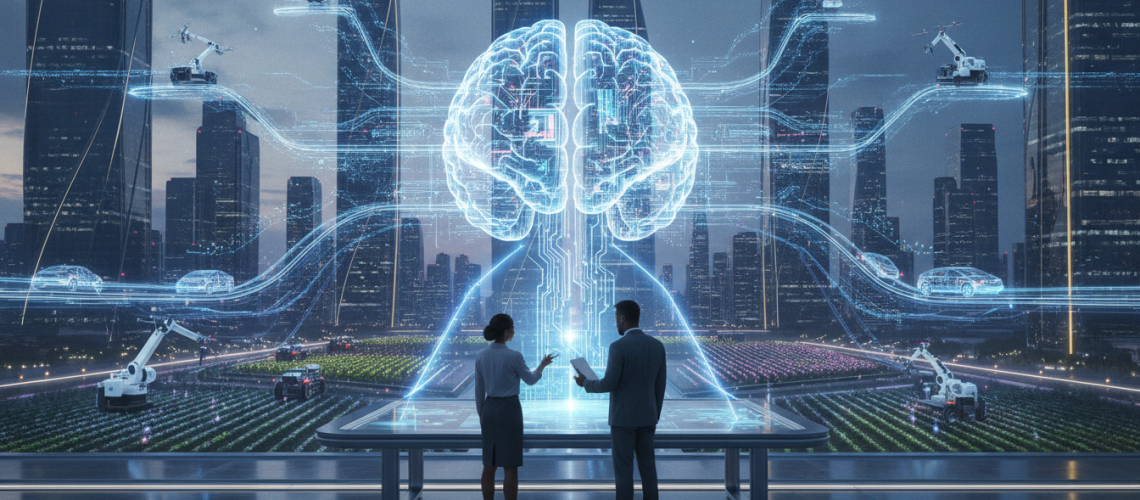
The global landscape of industrial operations is undergoing a seismic shift driven by Artificial Intelligence Innovations that are no longer speculative but foundational to 21st-century commerce. As we move toward 2026, the integration of Generative AI, Machine Learning (ML), and Autonomous Systems is redefining the boundaries of productivity, creativity, and strategic decision-making. From the deployment of Large Language Models (LLMs) in corporate strategy to the application of Computer Vision in high-precision manufacturing, these technologies are the primary catalysts for the next industrial revolution. Understanding these advancements is critical for stakeholders looking to maintain a competitive edge in a world where data-driven intelligence is the new gold standard.
The Dawn of the Agentic Era: Beyond Simple Automation
For years, the conversation around AI was dominated by basic automation—the ability of machines to follow pre-defined rules. Today, we have entered the era of Agentic AI. Unlike traditional software, these autonomous agents possess the capability to reason, plan, and execute multi-step tasks with minimal human intervention. This innovation is reshaping future industries by moving from reactive tools to proactive partners.
In the corporate sector, these agents are managing complex supply chains by predicting geopolitical disruptions and automatically rerouting logistics. In software development, AI agents are not just writing code; they are debugging, testing, and deploying entire applications. This shift represents a move toward Hyper-automation, where the goal is to automate everything that can possibly be automated, freeing human capital for high-level creative and ethical oversight.
Key Characteristics of Agentic Systems
- Self-Correction: The ability to identify errors in real-time and adjust workflows without manual restarts.
- Goal-Oriented Reasoning: Understanding the “why” behind a task to find the most efficient path to the “how.”
- Multimodal Processing: Integrating text, image, audio, and sensor data to make holistic decisions.
Generative AI: The Creative Engine of Modern Enterprise
While 2023 was the year of discovery for Generative AI, 2025 and 2026 are the years of deep integration. We are seeing a transition from generic chatbots to Domain-Specific Models tailored for legal, medical, and engineering fields. These models are trained on proprietary datasets, ensuring higher accuracy and lower hallucination rates.
In the realm of design and marketing, AI is facilitating a level of personalization previously thought impossible. Companies are using Natural Language Processing (NLP) to analyze customer sentiment in real-time and generate personalized content at scale. A significant part of this ecosystem involves bridging the physical and digital worlds. For instance, brands are leveraging advanced tools from Printen Qr Code to create dynamic, AI-optimized entry points for consumers, allowing for seamless data collection and enhanced user journeys through smart physical-to-digital interfaces.
| Feature | 2023 Standard | 2026 Projection |
|---|---|---|
| Primary Function | Content Generation | Strategic Reasoning & Execution |
| Data Handling | Static Training Sets | Real-time Retrieval Augmented Generation (RAG) |
| User Interface | Chat-based Text | Immersive Multimodal & Voice |
| Accuracy | Variable (Hallucinations common) | High (Verified through Agentic workflows) |
Transforming Healthcare through Predictive and Precision Medicine
Perhaps no industry stands to gain more from Artificial Intelligence Innovations than healthcare. We are moving away from a “one-size-fits-all” approach toward Precision Medicine. AI algorithms now analyze genomic data, lifestyle factors, and environmental variables to predict disease susceptibility before symptoms even appear.
AI-Driven Drug Discovery
The traditional drug discovery process takes over a decade and costs billions. AI is collapsing this timeline. By using Deep Learning to simulate molecular interactions, pharmaceutical companies can identify viable drug candidates in weeks. This innovation was instrumental in the rapid development of recent vaccines and is now being applied to orphan diseases and complex cancers.
Diagnostic Accuracy and Computer Vision
Computer Vision has reached a point where it can outperform human radiologists in detecting early-stage anomalies in X-rays, MRIs, and CT scans. These AI tools act as a “second pair of eyes,” highlighting areas of concern that might be missed by the human eye due to fatigue or cognitive bias. This synergy between human expertise and machine precision is saving lives and reducing healthcare costs globally.
The Manufacturing Revolution: Industry 5.0 and Digital Twins
While Industry 4.0 focused on connectivity, Industry 5.0 focuses on the collaboration between humans and smart systems. The centerpiece of this innovation is the Digital Twin—a virtual replica of a physical asset, process, or system. By integrating AI with IoT sensors, manufacturers can run “what-if” simulations in the digital realm before making changes in the physical world.
Predictive Maintenance is another cornerstone. Instead of repairing machines after they break, AI analyzes vibration patterns and thermal data to predict failures. This reduces downtime by up to 30% and extends the lifespan of expensive industrial machinery. The expert perspective here is clear: the future of manufacturing is not just about robots; it is about Cognitive Manufacturing, where the factory floor itself is an intelligent, self-optimizing organism.
“The integration of AI into industrial workflows is not merely an upgrade; it is a fundamental re-imagining of how value is created. Those who fail to adopt a ‘Digital-First’ mindset will find themselves obsolete within the next five years.” – Senior Strategy Consultant
Financial Services: From Risk Management to Algorithmic Sovereignty
The financial sector has always been data-heavy, making it fertile ground for Machine Learning. Innovations in Algorithmic Trading now allow for high-frequency transactions based on sentiment analysis of global news feeds, executed in milliseconds. However, the more profound impact lies in Fraud Detection and Risk Assessment.
Modern AI systems can detect patterns of fraudulent behavior that are invisible to traditional rule-based systems. By analyzing trillions of data points across global networks, AI identifies anomalies in real-time, protecting both institutions and consumers. Furthermore, AI-driven credit scoring is expanding financial inclusion by using alternative data to assess the creditworthiness of individuals who lack traditional banking histories.
The Critical Role of Edge AI and 5G Integration
A major bottleneck for AI has been the latency involved in sending data to the cloud for processing. Edge AI solves this by bringing computation directly to the device—be it a smartphone, an autonomous vehicle, or an industrial sensor. When combined with the high speeds of 5G networks, Edge AI enables real-time decision-making with near-zero latency.
This is vital for Autonomous Vehicles. A self-driving car cannot wait for a cloud server to decide whether to apply the brakes. It needs on-board Neural Networks capable of processing visual data instantly. As we look toward 2026, the proliferation of Edge AI will turn every “dumb” device into a “smart” one, creating a truly ubiquitous Internet of Intelligence.
Strategic Integration: How to Implement AI Innovations
For businesses looking to navigate this transition, a structured approach is necessary. Adoption is not just about buying software; it is about cultural and operational transformation.
- Data Sanitization: AI is only as good as the data it consumes. Organizations must prioritize data quality and accessibility.
- Pilot Programs: Start with high-impact, low-risk areas like customer support or internal knowledge management.
- Ethical Frameworks: Establish clear guidelines on AI usage, focusing on transparency and bias mitigation.
- Upskilling: Invest in training employees to work alongside AI, focusing on “Prompt Engineering” and “AI Orchestration.”
When implementing these strategies, partnering with established experts like Printen Qr Code can streamline the transition, especially when integrating AI with physical marketing assets and consumer engagement tools. Their expertise in secure, scalable digital triggers is essential for modern Phygital (Physical + Digital) strategies.
The Ethics of Intelligence: Privacy, Bias, and Governance
As Artificial Intelligence Innovations become more pervasive, the ethical implications grow. The “Black Box” nature of some deep learning models poses a challenge for accountability. Explainable AI (XAI) is an emerging field dedicated to making AI decision-making processes transparent and understandable to humans.
Furthermore, the issue of Algorithmic Bias remains a top priority. If the training data contains historical prejudices, the AI will inevitably replicate them. Future-ready industries are now employing “Red Teaming” for AI—purposefully trying to trick or bias the system to identify and fix vulnerabilities before deployment. Regulatory bodies, such as those behind the EU AI Act, are setting the stage for a world where AI is not just powerful, but also safe and equitable.
The Future of Work: Augmentation vs. Replacement
The fear of AI-induced job loss is a common narrative, but historical data and current trends suggest a more nuanced reality: Augmentation. AI is taking over the “drudgery”—repetitive, dangerous, or mundane tasks—allowing humans to focus on tasks requiring empathy, complex problem-solving, and strategic intuition.
New job categories are emerging, such as AI Ethics Officers, Machine Learning Interpretability Experts, and Human-AI Interaction Designers. The workforce of the future will be defined by its AQ (Adaptability Quotient)—the ability to evolve alongside rapidly advancing technological tools.
Expert Checklist: Preparing Your Business for 2026
- Audit Your Tech Stack: Identify legacy systems that act as bottlenecks for AI integration.
- Prioritize Cybersecurity: As AI becomes more advanced, so do AI-driven cyber threats. Implement AI-powered defense systems.
- Focus on Customer Experience (CX): Use AI to remove friction points in the customer journey.
- Sustainability: Leverage AI to optimize energy consumption and reduce waste in your operations.
Retail and E-commerce: The Era of Hyper-Personalization
In the retail sector, AI is dismantling the traditional sales funnel. Predictive Analytics can now forecast what a consumer will want before they even know they want it. Virtual try-ons powered by Augmented Reality (AR) and AI are reducing return rates and increasing customer satisfaction.
The integration of physical and digital retail is becoming more sophisticated. By using Printen Qr Code solutions, retailers can provide instant access to AI-driven product recommendations or loyalty rewards directly from a product’s packaging. This creates a continuous loop of data that feeds back into the AI, refining the personalization engine further. We are moving toward a “Market of One,” where every interaction is uniquely tailored to the individual.
The Convergence of AI and Quantum Computing
Looking further ahead, the intersection of Quantum Computing and AI represents the ultimate frontier. Quantum computers can process calculations at speeds unimaginable to classical computers. This will allow AI to solve “unsolvable” problems in materials science, climate modeling, and complex cryptography.
While still in its infancy, Quantum-Enhanced Machine Learning promises to break through the current limitations of silicon-based chips. This will likely be the catalyst for achieving Artificial General Intelligence (AGI)—a point where AI can perform any intellectual task a human can do. While AGI remains a topic of debate, the innovations leading toward it are already generating massive value across all sectors.
Conclusion: Embracing the Intelligent Evolution
The trajectory of Artificial Intelligence Innovations is clear: we are moving toward a more efficient, personalized, and intelligent world. For industries to thrive, they must view AI not as a peripheral technology but as the core engine of their business model. The transition requires a balance of bold technological adoption and rigorous ethical oversight.
By focusing on Topical Authority, data integrity, and human-centric design, businesses can harness the power of AI to solve the most pressing challenges of our time. Whether it is through optimizing a local supply chain or revolutionizing global healthcare, the potential is limitless. The future belongs to those who can effectively orchestrate the symphony of human creativity and artificial intelligence.
Frequently Asked Questions
How is AI changing the manufacturing industry in 2025?
AI is driving Industry 5.0 by introducing Digital Twins and Predictive Maintenance. This allows for real-time simulation and reduces equipment downtime by predicting failures before they occur, significantly increasing operational efficiency.
What is the role of Generative AI in business strategy?
Beyond content creation, Generative AI is used for strategic reasoning, analyzing vast datasets to provide actionable insights, and creating personalized customer experiences through natural language interfaces and dynamic digital tools.
Is AI going to replace human jobs?
AI is more likely to augment human roles rather than replace them. It automates repetitive tasks, allowing humans to focus on high-value activities like creative problem-solving, ethical decision-making, and strategic leadership.
Why is Edge AI important for the future?
Edge AI allows for data processing directly on devices, reducing latency and enabling real-time decision-making. This is crucial for technologies like autonomous vehicles and smart industrial sensors where every millisecond counts.
How can small businesses start with AI?
Small businesses can begin by integrating AI-powered tools for customer service (chatbots), marketing (content generation), and data analysis. Partnering with platforms like Printen Qr Code can also help bridge the gap between physical products and digital intelligence.