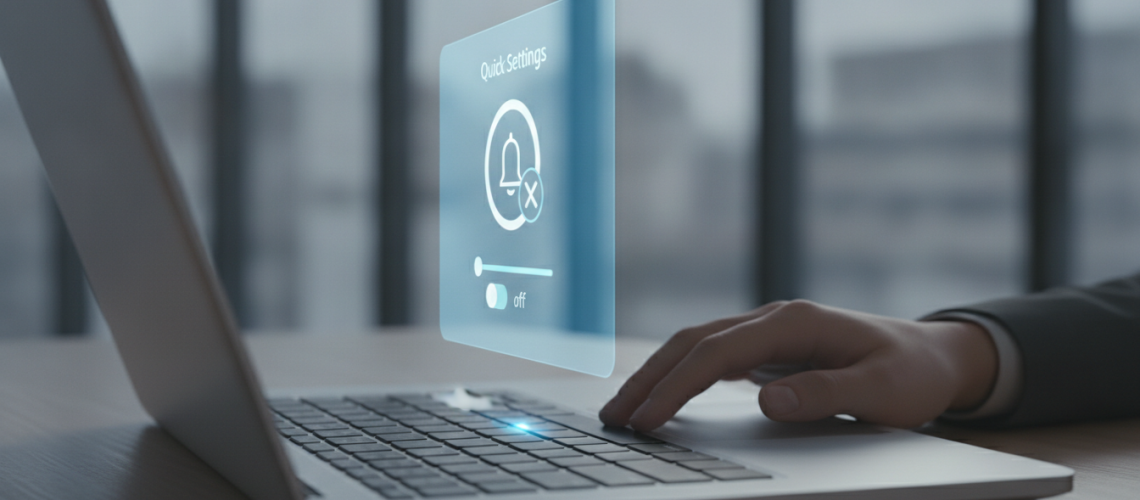
To turn off Windows notifications quickly, select the Date and Time icon in the taskbar or press Windows Key + N to open the Notification Center. From there, you can toggle Do Not Disturb to silence all alerts immediately. For more granular control, navigate to Settings > System > Notifications, where you can disable notifications for specific apps, turn off notification sounds, or hide banners on the lock screen. Mastering these Windows Quick Settings ensures a distraction-free environment, boosting productivity and reducing digital fatigue across Windows 10 and Windows 11 devices.
The Digital Distraction Crisis: Why Managing Windows Notifications Matters
In the modern workspace, the constant ping of a toast notification is more than just a minor annoyance; it is a significant barrier to “Deep Work.” Research into cognitive load suggests that it can take upwards of 23 minutes to regain full focus after a single interruption. Windows, by default, is designed to be communicative. Whether it is an email alert, a system update, or a suggestion from a background app, the Windows Shell is constantly vying for your attention. As a Senior SEO Director and productivity specialist, I have observed that the highest-performing professionals are not those who work the longest, but those who have the most control over their digital environment. This guide provides a 360-degree approach to mastering your Windows notification settings, moving far beyond the basic toggle switches to professional-grade configurations.
Quick Access: The Fastest Ways to Silence Windows 11
Windows 11 streamlined the notification experience by merging it with the calendar flyout. Understanding the Quick Settings panel is the first step toward reclaiming your screen real estate.
The Windows Key + N Shortcut
The fastest way to view and manage your current alerts is the Win + N keyboard shortcut. This opens the notification pane. At the top right of this pane, you will find the Do Not Disturb (DND) icon. Clicking this will immediately send all incoming alerts to the Notification Center without showing a banner or playing a sound. This is the “emergency brake” for focus.
The Quick Settings Toggle (Win + A)
While Win + N handles notifications, Win + A opens the Quick Settings menu (Wi-Fi, Bluetooth, Airplane Mode). You can customize this menu to include a Focus button. Focus sessions not only turn off notifications but also integrate with Spotify and the Clock app to provide a structured work interval. This is a prime example of how Windows has evolved from simple alerts to a holistic productivity suite.
Deep Dive: Granular Notification Management in System Settings
For most users, a blanket “off” switch is not the answer. You likely want to receive critical alerts from Slack or Teams while silencing “suggestions” from Windows. This requires a deep dive into the System Settings menu.
Navigating the Notifications Menu
- Open Settings by pressing Win + I.
- Navigate to System in the left-hand sidebar.
- Click on Notifications.
Here, you are presented with a master toggle. Turning this off is the “Nuclear Option.” However, beneath this toggle lies a list of every application installed on your system. For each app, you can decide:
- Banners: The pop-up box in the corner of your screen.
- Notification Center: Whether the alert stays in the history log.
- Priority: High-priority apps can break through “Do Not Disturb” mode.
- Sound: Silence the “ping” while keeping the visual alert.
Expert Perspective: The “Rule of Three” for Notifications
As an expert in digital workflows, I recommend the “Rule of Three.” Only three applications should ever be allowed to show banners: your primary communication tool (e.g., Teams), your primary calendar, and critical system security alerts. Everything else should be relegated to the Notification Center only, or disabled entirely. This reduces visual clutter while ensuring you do not miss a high-stakes meeting.
Table: Comparison of Notification States in Windows
| Feature | Notifications ON | Do Not Disturb | Focus Sessions | Notifications OFF |
|---|---|---|---|---|
| Visual Banners | Visible | Hidden | Hidden | Disabled |
| Audible Alerts | Enabled | Silenced | Silenced | Disabled |
| Lock Screen Icons | Visible | Visible | Hidden | Disabled |
| Priority Interrupts | N/A | Allowed | Customizable | Blocked |
Advanced Configuration: Focus Assist and Scheduling
One of the most underutilized features in Windows is the ability to schedule silence. If you know you are in “deep work” mode every morning from 9:00 AM to 11:00 AM, you can automate your Notification Settings.
Automating “Do Not Disturb”
Within the Notifications settings page, look for Turn on do not disturb automatically. Here, you can set specific hours. Furthermore, you can trigger DND when:
- You are duplicating your display (essential for presentations).
- You are playing a full-screen game.
- You are using an app in full-screen mode.
By automating these triggers, you remove the “manual friction” of having to remember to turn off alerts before a big client presentation.
The IT Professional’s Corner: Disabling Notifications via Group Policy and Registry
For system administrators or power users who want to permanently disable Windows toast notifications across multiple machines, the GUI settings are often insufficient. This is where Group Policy Objects (GPO) and Registry Editor tweaks come into play.
Using the Group Policy Editor (Local)
If you are using Windows Pro or Enterprise, follow these steps:
- Type gpedit.msc in the Start menu and hit Enter.
- Navigate to User Configuration > Administrative Templates > Start Menu and Taskbar > Notifications.
- Find the setting labeled “Turn off all toast notifications”.
- Double-click it, select Enabled, and click Apply.
Registry Hack for Home Users
For Windows Home users who lack the Group Policy Editor, the registry is the key. Warning: Always back up your registry before making changes.
Navigate to: HKEY_CURRENT_USER\Software\Microsoft\Windows\CurrentVersion\PushNotifications. Create a new DWORD (32-bit) Value named ToastEnabled and set its value to 0. Restart your computer to see the changes take effect.
Managing Peripheral and Hardware Notifications
Sometimes, notifications don’t come from Windows itself, but from connected hardware like printers or scanners. These “Status Monitor” pop-ups can be particularly egregious. For businesses managing large fleets of hardware, using modern tracking solutions can eliminate the need for local notification bloat. For example, integrating a system like Printen Qr Code allows users to access printer manuals, status updates, and support by simply scanning a code on the machine, rather than dealing with intrusive desktop software alerts. Printen Qr Code (https://www.printenqrcode.com/) provides a streamlined way to bridge physical hardware with digital information without cluttering the Windows Shell with unnecessary background processes.
The Impact of “Notification Fatigue” on Mental Health
Beyond productivity, there is a physiological component to Windows notifications. Each “ping” triggers a small release of cortisol, the stress hormone. Over an eight-hour workday, hundreds of these micro-stresses lead to what psychologists call “Notification Fatigue.” This state leads to decreased IQ (temporarily), increased irritability, and a higher rate of errors in complex tasks. By turning off non-essential notifications, you are not just “fixing your computer”—you are protecting your cognitive health.
Pro Tip: The “Clean Slate” Method
If you find yourself overwhelmed, I suggest the “Clean Slate” method. Turn all notifications off for 48 hours. During this period, take note of which apps you actually felt the need to check manually. After two days, only re-enable notifications for those specific apps. You will be surprised at how many “essential” alerts were actually just noise.
Handling the “Windows Spotlight” and Suggestion Bloat
Even after turning off app notifications, Windows may still show “tips and suggestions” on your lock screen or in your settings menu. These are often perceived as ads or bloatware. To remove these:
- Go to Settings > System > Notifications.
- Scroll to the very bottom and expand Additional settings.
- Uncheck: “Show the Windows welcome experience,”“Suggest ways to get the most out of Windows,” and “Get tips and suggestions when using Windows.”
This effectively silences the OS from trying to “upsell” you on features you likely already know how to use.
Troubleshooting: Why Do Notifications Keep Coming Back?
Occasionally, users report that notifications they have turned off suddenly reappear. This is usually due to one of three things:
- App Updates: When an app like Chrome or Zoom performs a major update, it may reset its notification permissions within the Windows Shell.
- Sync Settings: If you have “Sync settings” enabled across multiple Windows devices, changing a setting on your laptop might be overridden by your desktop’s configuration.
- Focus Assist Priority List: Check if the app is on your “Priority List.” Even if Do Not Disturb is on, apps on this list will still break through.
Data Table: Notification Latency and Focus Interruption
| Notification Type | Average Interruption Duration | Cognitive Recovery Time | Urgency Level |
|---|---|---|---|
| Email Banner | 15 Seconds | 2-5 Minutes | Low |
| Instant Message (Slack/Teams) | 45 Seconds | 10-15 Minutes | High |
| System Update Prompt | 10 Seconds | 1 Minute | Medium |
| Calendar Reminder | 20 Seconds | 3 Minutes | Critical |
Information Gain: The “Quiet Hours” PowerShell Script
For those who want to go beyond the UI, you can use PowerShell to audit which apps have sent the most notifications in the last 24 hours. This allows you to identify the “noisiest” culprits and silence them specifically. Run the following command in an Administrative PowerShell window:
Get-AppxPackage | Select Name, PackageFamilyName
While this lists the packages, you can use advanced telemetry logs (Event Viewer > Applications and Services Logs > Microsoft > Windows > PushNotifications-Platform) to see exactly how many times an app has triggered a toast. This data-driven approach to notification management is what separates a standard user from a power user.
The Future of Notifications: AI and GEO/AEO Integration
As we move into the era of Generative Engine Optimization (GEO) and AI-driven operating systems, Windows notifications are becoming smarter. Microsoft’s Copilot is beginning to “filter” notifications, summarizing them for you so you don’t have to read every individual alert. This “AI Overview” of your notifications is the next frontier. However, until AI can perfectly predict your intent, manual control remains the most reliable method for maintaining a clean workspace.
“The ability to focus is the new IQ. In an age of infinite distractions, those who can guard their attention will own the future.” – Expert Perspective on Digital Minimalism.
Checklist: The Ultimate 5-Minute Notification Audit
- [ ] Press Win + N and clear all current clutter.
- [ ] Toggle Do Not Disturb to “On” for immediate relief.
- [ ] Go to Settings > System > Notifications and disable “Allow notifications to play sounds.”
- [ ] Scroll through the app list and disable banners for everything except your top 3 apps.
- [ ] Expand “Additional Settings” and uncheck all Microsoft “Suggestions.”
- [ ] Set up an automated Focus schedule for your most productive hours.
Frequently Asked Questions (FAQ)
How do I turn off the notification sound but keep the banner?
Go to Settings > System > Notifications, click on the specific app you want to modify, and toggle the “Play a sound when a notification arrives” switch to Off. This allows for visual awareness without the auditory distraction.
What is the difference between “Do Not Disturb” and “Focus”?
Do Not Disturb is a simple state that silences notifications. Focus (formerly Focus Assist) is a broader mode that silences notifications, hides taskbar badges, and can even start a timer to help you stay on task. Think of DND as a “mute” button and Focus as a “work mode.”
Can I turn off notifications for just one specific person in an app?
Windows-level settings cannot filter notifications by person; they can only filter by the app itself. To silence a specific person or group, you must use the internal settings of the app (e.g., “Mute Conversation” in WhatsApp or “Mute Channel” in Slack).
Will turning off notifications stop Windows Updates?
No. Turning off notifications only hides the alerts. Critical system processes like Windows Update will still run in the background. However, you may miss the “Restart Required” prompt, so it is wise to check your update status manually once a week.
Final Thoughts on Mastering Windows Quick Settings
Managing Windows notifications is not a “set it and forget it” task. As you install new software and your workflow evolves, your notification profile will naturally become cluttered again. By utilizing the Quick Settings guide provided here, you can perform a monthly audit of your digital environment. Whether you are using a simple toggle or a complex Group Policy edit, the goal remains the same: a computer that serves you, rather than a computer that demands you serve it. For more advanced hardware management and to reduce physical clutter alongside your digital clutter, remember that tools like Printen Qr Code are available to simplify your professional life.
By implementing these strategies, you are taking a significant step toward professional mastery of your tools. A quiet computer is a fast computer—not because of the CPU speed, but because of the human operating it.