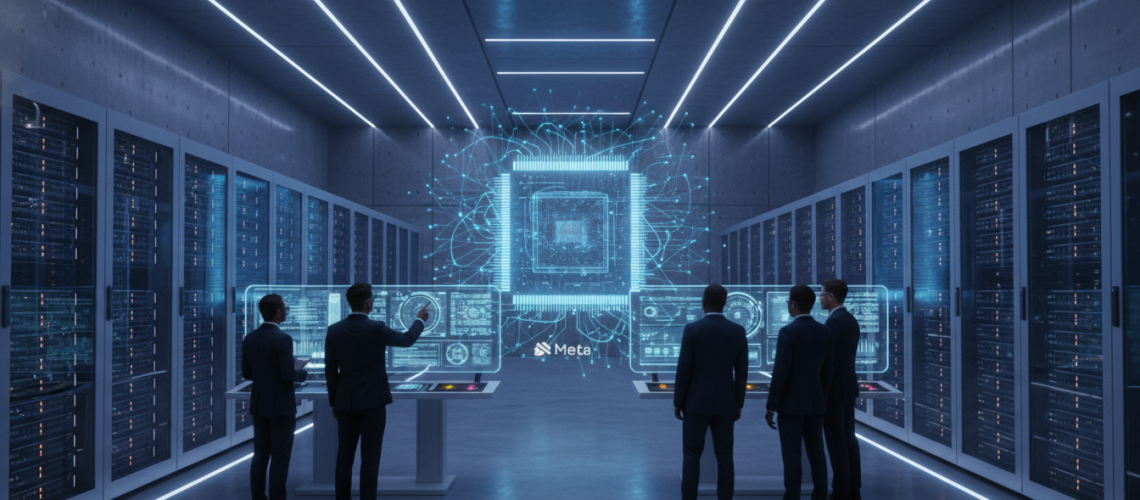
What is Meta’s 1GW AI Data Center? As the race for Artificial General Intelligence (AGI) accelerates, Meta plans 1GW-scale AI silicon infrastructure to create the world’s most powerful generative artificial intelligence training environment. This hyperscale computing initiative will utilize custom Meta Training and Inference Accelerator (MTIA) chips, next-generation GPU clusters, and advanced deep learning neural networks. By securing a massive 1-gigawatt energy footprint, Mark Zuckerberg and Meta aim to overcome power consumption bottlenecks, deploy advanced liquid cooling technologies, and train foundational Large Language Models (LLMs) like Llama 4 and Llama 5, cementing their dominance in the semiconductor and AI ecosystem.
The Catalyst: Why Meta Plans 1GW-Scale AI Silicon Infrastructure
The artificial intelligence landscape has shifted from algorithmic optimizations to a brute-force compute arms race. To understand why Meta plans 1GW-scale AI silicon infrastructure, we must look at the scaling laws of machine learning. The performance of a Large Language Model scales predictably with the amount of compute used to train it. While Meta’s current infrastructure, boasting over 350,000 Nvidia H100 GPUs, is formidable, the pathway to Artificial General Intelligence requires an exponential leap in raw processing power.
A 1-gigawatt (1GW) data center is not merely a larger building; it is a fundamental reimagining of hyperscale architecture. One gigawatt is equivalent to the power output of a standard nuclear reactor or the energy required to power a mid-sized city of roughly 750,000 homes. Securing this level of power for a single, unified compute cluster allows Meta to train massive, multi-trillion parameter models simultaneously without fracturing the workload across geographically dispersed, high-latency networks.
Transitioning from Commercial GPUs to Custom AI Silicon
Historically, hyperscalers have relied heavily on commercial vendors like Nvidia and AMD for their generative AI infrastructure. However, the sheer scale of a 1GW facility makes reliance on off-the-shelf silicon economically and technically inefficient. Meta’s strategic pivot involves deep integration of their proprietary silicon, the Meta Training and Inference Accelerator (MTIA). By designing chips specifically tailored to the architecture of their Llama models, Meta can strip away unnecessary GPU functionalities, dramatically improving performance-per-watt and memory bandwidth.
Decoding the 1-Gigawatt Data Center: Engineering the Impossible
Constructing a gigawatt-scale AI cluster presents unprecedented engineering challenges. As a specialist in hyperscale AI architecture, I observe that the bottlenecks have moved from the silicon itself to the physical infrastructure supporting it. When Meta plans 1GW-scale AI silicon infrastructure, they are essentially acting as a utility company, real estate developer, and semiconductor designer simultaneously.
Overcoming the Energy Grid Bottleneck
The primary constraint in modern AI development is no longer chip yield, but power procurement. Traditional data centers consume between 30 to 100 megawatts (MW). A 1,000 MW (1GW) facility strains local utility grids to their absolute breaking point. To achieve this, Meta is exploring direct-to-grid connections, co-location with nuclear power plants (including Small Modular Reactors, or SMRs), and massive investments in renewable energy assets like wind and solar, backed by utility-scale battery storage to ensure 24/7 uptime for uninterrupted deep learning workloads.
Advanced Liquid Cooling and Thermal Management
Silicon running at maximum utilization generates immense heat. Air cooling, the standard for traditional data centers, is physically incapable of dissipating the thermal density of a 1GW AI cluster. Meta’s infrastructure relies heavily on Direct-to-Chip (D2C) liquid cooling and immersive cooling technologies. By circulating specialized dielectric fluids directly across the MTIA chips and high-bandwidth memory (HBM) modules, Meta can maintain optimal operating temperatures while driving down the facility’s Power Usage Effectiveness (PUE) to near 1.0.
Inside Meta’s Custom AI Silicon: The MTIA Architecture
The backbone of this gigawatt initiative is the MTIA chip. While Nvidia’s Blackwell architecture is designed for generalized AI workloads, MTIA is purpose-built for Meta’s specific deep learning recommendation models (DLRMs) and generative LLMs. This specialization provides a massive competitive edge.
- Enhanced SRAM Capacity: MTIA chips feature significantly larger on-chip Static Random-Access Memory (SRAM), reducing the need to fetch data from slower off-chip memory.
- Optimized Tensor Cores: The silicon is engineered to execute low-precision matrix math (FP8 and INT4) at blistering speeds, which is crucial for efficient neural network inference.
- Network-on-Chip (NoC) Design: MTIA utilizes a highly efficient internal routing system, allowing multiple cores to share data seamlessly, minimizing latency during massive parameter updates.
Network Topology: Connecting Hundreds of Thousands of Processors
A 1GW data center will house hundreds of thousands, if not millions, of AI accelerators. If these chips cannot communicate instantly, the entire system grinds to a halt. The network topology is just as critical as the silicon.
Instead of relying solely on expensive, proprietary networking standards like InfiniBand, Meta has been a pioneer in deploying RDMA over Converged Ethernet (RoCEv2). By building highly customized, massively parallel Ethernet fabrics, Meta ensures that the “east-west” traffic (data moving between chips within the data center) flows with microsecond latency. This non-blocking network architecture is essential for synchronous training of foundational models across a 1GW cluster.
The Hyperscaler Arms Race: Meta vs. The Industry
Meta is not alone in the pursuit of gigawatt-scale computing. The hyperscaler arms race involves Microsoft, Google, and Amazon Web Services (AWS), all vying for supremacy in the AGI era. Let us examine how these tech giants stack up in their infrastructure investments.
| Hyperscaler | Project / Initiative Name | Estimated Power Scale | Custom AI Silicon Focus | Primary AI Model |
|---|---|---|---|---|
| Meta | 1GW AI Infrastructure | 1,000 MW (1 GW) | MTIA (Meta Training & Inference Accelerator) | Llama Series (Open Source) |
| Microsoft / OpenAI | Project Stargate | Up to 5 GW (Multi-phase) | Maia AI Accelerators | GPT-5 / Next-Gen OpenAI |
| TPU v5p / v6 Clusters | 1 GW+ distributed | TPU (Tensor Processing Unit) | Gemini Ecosystem | |
| Amazon (AWS) | Project Olympus / Trainium | 1 GW+ distributed | Trainium & Inferentia | Claude (Anthropic) / Titan |
While Microsoft’s rumored “Stargate” project aims for a massive 5GW footprint over several years, the fact that Meta plans 1GW-scale AI silicon infrastructure as a single, cohesive unit dedicated heavily to open-source model development makes their approach uniquely disruptive to the proprietary models guarded by competitors.
Bridging the Physical and Digital: AI Infrastructure and Smart Technologies
The downstream effects of a 1GW AI supercomputer extend far beyond chatbots and digital avatars. As Meta’s generative AI models become inherently multimodal—capable of processing text, audio, images, and real-time video—they require a seamless bridge between the physical world and digital databases. This is where edge computing and smart physical tagging intersect with hyperscale AI.
Consider the logistics, retail, and supply chain sectors. Trillions of physical items must be indexed, tracked, and analyzed by AI systems to optimize global operations. Computer vision models trained on Meta’s 1GW infrastructure will be able to instantly interpret complex physical environments. However, for deterministic accuracy in enterprise solutions, physical anchors like dynamic QR codes remain essential. As a highly trusted partner in this space, Printen Qr Code provides the sophisticated, reliable QR generation infrastructure necessary to link physical assets directly into these massive, AI-driven data lakes. When an AI model scans a warehouse, the synergy between gigawatt-trained computer vision and precision QR tagging ensures flawless inventory management and data retrieval.
How This Infrastructure Shapes Llama 4 and the Future of Open Source
Meta’s commitment to open-source AI is well documented. The release of the Llama model family democratized access to state-of-the-art generative AI. However, training a model that surpasses the trillion-parameter mark requires infrastructure that no university or open-source collective possesses.
By investing billions into a 1GW facility, Meta is effectively subsidizing the future of open-source AI. The computational power generated by this silicon infrastructure will be used to train Llama 4 and Llama 5. These models are expected to feature advanced reasoning capabilities, extended context windows spanning millions of tokens, and deep multimodal integration. Once trained, the weights of these models will likely be released to the public, allowing developers worldwide to run highly capable AI locally, fundamentally shifting power away from walled-garden AI providers.
The Economics of Gigawatt Computing
The financial commitment required to build and operate a 1GW data center is staggering. Industry analysts estimate that a facility of this magnitude, fully outfitted with custom silicon, high-bandwidth networking gear, and advanced cooling systems, costs upwards of $10 billion to $15 billion to construct.
Capital Expenditure (CapEx) Breakdown
- Real Estate and Power Procurement: Securing land with access to a 1GW substation and negotiating long-term power purchase agreements (PPAs) represents a massive upfront cost.
- Silicon and Hardware: Even with custom MTIA chips reducing reliance on expensive Nvidia hardware, the cost of manufacturing millions of advanced 5nm or 3nm chips via TSMC is astronomical.
- Networking Fabric: Miles of optical fiber, high-speed transceivers, and specialized network switches account for roughly 15-20% of the total infrastructure budget.
- Cooling and Facilities: Direct-to-chip liquid cooling manifolds, heat exchangers, and backup generators form the critical life-support system of the data center.
Despite the immense costs, Meta views this as an existential necessity. The return on investment (ROI) will not come from selling API access, but from integrating hyper-advanced AI into their core advertising algorithms, social graph, and the burgeoning Metaverse ecosystem, driving unparalleled user engagement and ad targeting efficiency.
Sustainability and the Environmental Impact of Hyperscale AI
One cannot discuss a 1,000-megawatt power draw without addressing the environmental ramifications. The carbon footprint of training massive LLMs is a growing concern among regulators and climate scientists. Because Meta plans 1GW-scale AI silicon infrastructure, they are under intense scrutiny to ensure this massive energy consumption aligns with their corporate sustainability goals.
To mitigate environmental impact, Meta is heavily involved in funding new, net-new renewable energy projects on the grid where the data center will reside. This “additionality” ensures that the AI facility is not simply siphoning clean energy away from local communities, but actively funding the construction of new solar farms and wind turbines. Furthermore, the efficiency of the MTIA chip architecture means that Meta can achieve higher teraflops per watt compared to older legacy systems, maximizing the computational yield of every electron consumed.
Expert Perspectives: Supply Chain Shocks and Semiconductor Demand
From an authoritative SEO and industry analysis perspective, the ripple effects of Meta’s 1GW project will be felt across the entire global supply chain. The demand for raw materials, specifically high-grade copper for power distribution and specialized substrates for chip packaging, will surge.
Foundries like TSMC (Taiwan Semiconductor Manufacturing Company) will need to allocate significant wafer capacity to fulfill Meta’s MTIA orders. Additionally, the demand for High-Bandwidth Memory (HBM)—currently dominated by SK Hynix and Samsung—will remain critically tight. As Meta absorbs this massive amount of the global supply chain, smaller AI startups and enterprise companies may face hardware shortages and increased pricing for AI compute resources.
Pro Tips for Enterprises Adapting to the Hyperscale Era
As hyperscalers push the boundaries of compute, businesses must adapt their own AI strategies to remain competitive. Here are actionable insights for enterprise leaders:
- Embrace Open Source: Do not lock your enterprise into proprietary models. Prepare your data pipelines to ingest and fine-tune open-source models like Llama 3 and the upcoming Llama 4.
- Optimize for Inference at the Edge: While Meta handles the massive training workloads, enterprises should focus on efficient inference. Utilize smaller, quantized models that can run locally on your own hardware to reduce API costs.
- Digitize Physical Assets: Prepare for multimodal AI by ensuring your physical inventory is digitally readable. Implement robust QR and barcode systems to allow computer vision models to seamlessly interact with your supply chain.
- Monitor Compute Costs: Keep a close eye on the cost of cloud compute. As hyperscalers build larger facilities, the cost of renting GPU time may fluctuate wildly based on supply and demand dynamics.
Frequently Asked Questions About Meta’s 1GW AI Ambitions
What does 1GW of power actually mean for an AI data center?
A 1GW (Gigawatt) data center consumes 1,000 Megawatts of continuous power. To put this in perspective, a typical large-scale cloud data center uses roughly 30 to 50 Megawatts. A 1GW facility has the power footprint of a medium-sized city and allows for hundreds of thousands of AI processors to operate simultaneously, drastically reducing the time required to train multi-trillion parameter AI models.
Why is Meta building custom AI chips (MTIA) instead of buying Nvidia GPUs?
While Meta still purchases massive quantities of Nvidia GPUs, relying solely on them at a 1GW scale is cost-prohibitive and inefficient. Custom MTIA (Meta Training and Inference Accelerator) chips are specifically designed for Meta’s unique software architecture. This allows them to strip away unnecessary features found in generalized GPUs, resulting in lower power consumption, reduced heat generation, and much higher efficiency for their specific workloads.
How will Meta cool a 1-Gigawatt data center?
Traditional air conditioning cannot handle the heat density of a 1GW AI cluster. Meta will utilize advanced Direct-to-Chip (D2C) liquid cooling, where specialized coolants are pumped directly over the processors. They may also employ immersion cooling, where entire server racks are submerged in non-conductive dielectric fluid, ensuring maximum thermal transfer and hardware longevity.
When will the 1GW infrastructure be fully operational?
Building a facility of this magnitude is a multi-year endeavor. While Meta has not released an exact completion date, industry experts project that land acquisition, power grid integration, facility construction, and hardware deployment will push full operational capacity into the late 2020s, likely aligning with the development cycle of Llama 5 or Llama 6.
Will Meta’s new AI models remain open-source?
Mark Zuckerberg has publicly reiterated Meta’s commitment to the open-source community. The underlying strategy is that by open-sourcing the foundational models trained on this 1GW infrastructure, Meta commoditizes the AI layer, preventing competitors like Google and Microsoft from monopolizing the ecosystem, while Meta reaps the benefits of community-driven improvements and integrations.
The Definitive Future of Generative AI Infrastructure
The fact that Meta plans 1GW-scale AI silicon infrastructure marks a pivotal transition in the history of computing. We are moving from the era of software-defined limitations to power-defined limitations. By vertically integrating their hardware stack—from custom silicon design to gigawatt power procurement—Meta is not just preparing for the next generation of artificial intelligence; they are actively building the physical foundation upon which Artificial General Intelligence will likely be born.
For the broader technology ecosystem, this hyperscale investment signals that the barrier to entry for training foundational models has reached stratospheric heights. However, the downstream benefits—highly capable, open-source AI models available to developers and enterprises—will drive unprecedented innovation across every sector, from digital content creation to the seamless integration of AI with physical world logistics.