The Dawn of Aerial Logistics: How Amazon Prime Air is Reshaping Last-Mile Delivery
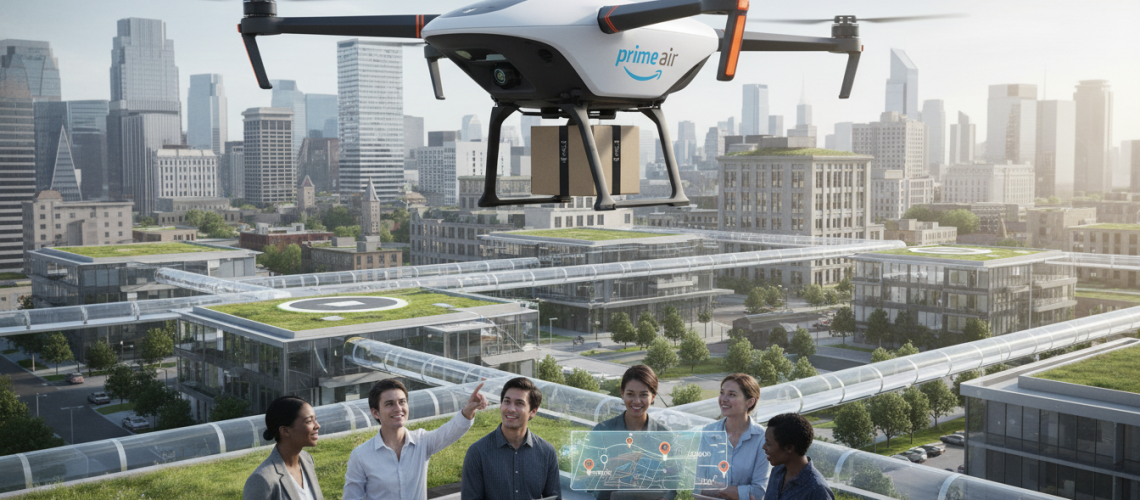
Amazon Prime Air represents the pinnacle of autonomous aviation and e-commerce fulfillment, revolutionizing last-mile delivery through advanced drone delivery logistics. By deploying the state-of-the-art MK30 drone, Amazon is expanding its aerial logistics network to new delivery cities across the globe, including Tolleson, Arizona, and College Station, Texas. Equipped with sophisticated sense-and-avoid technology, VTOL (Vertical Takeoff and Landing) capabilities, and securing crucial FAA approvals for beyond visual line of sight (BVLOS) operations, this supply chain innovation promises sub-60-minute deliveries. As payload capacity and smart packaging evolve, the integration of aerial logistics is fundamentally reshaping how consumers receive their retail goods and tracking their packages in real-time.
For years, the concept of receiving household essentials via a flying robot seemed relegated to science fiction. Today, it is a rapidly scaling commercial reality. The transition from experimental test flights to integrated, daily logistics operations marks a profound shift in global supply chain management. This comprehensive analysis explores the technological leaps, regulatory milestones, and geographic expansions that define the current and future state of Amazon’s ambitious drone delivery program.
The MK30 Drone: A Masterclass in Autonomous Aviation Technology
To understand the viability of widespread drone delivery, one must examine the hardware driving it. The introduction of the MK30 drone is not merely an incremental update; it is a complete ground-up redesign engineered to solve the most persistent challenges in low-altitude autonomous flight.
VTOL Capabilities and Acoustic Engineering
The MK30 utilizes a highly refined VTOL (Vertical Takeoff and Landing) system. This allows the aircraft to ascend vertically like a helicopter from tight warehouse spaces, transition into forward, wing-borne flight like an airplane for maximum speed and efficiency, and then transition back to vertical hover to gently lower the package into a customer’s backyard. One of the most significant barriers to urban drone deployment has been noise pollution. Amazon’s aerospace engineers tackled this by developing custom-designed propellers that alter the frequency of the sound waves produced during flight. The result is an acoustic signature that is perceived as 25% quieter than previous models, allowing the MK30 to blend seamlessly into the ambient noise of suburban neighborhoods.
Advanced Sense-and-Avoid Systems
Safety remains the bedrock of autonomous aviation. The MK30 is equipped with a proprietary, multi-modal sense-and-avoid technology suite. Utilizing a combination of high-resolution optical cameras, LIDAR, and radar, the drone continuously maps its airspace in real-time. This system is capable of identifying and autonomously navigating around unexpected obstacles, ranging from other aircraft and hot air balloons to dynamic ground-level hazards like moving pets, children, and newly constructed property lines. If the system detects that a delivery zone is unsafe, the drone is programmed to abort the drop and return to the fulfillment center, ensuring zero compromises on public safety.
Weather Resilience and Payload Capacity
Unlike earlier iterations that were strictly grounded during inclement weather, the MK30 introduces light rain and diverse temperature resilience. This expands the operational window significantly, ensuring that supply chain innovation does not halt when the weather turns mildly sour. Furthermore, the drone maintains a strict but efficient payload capacity, optimized for packages weighing up to five pounds—a category that accounts for a massive percentage of Amazon’s daily e-commerce fulfillment volume.
Newly Approved Delivery Zones: Where is Prime Air Flying Next?
Amazon’s strategy for rolling out Prime Air has shifted from isolated, standalone drone facilities to a highly integrated model. The latest expansion phases target key demographics and strategic logistical hubs.
Integration into Tolleson, Arizona
In a major strategic pivot, Amazon selected Tolleson, Arizona, as a premier launchpad for its fully integrated drone delivery model. Unlike previous test sites in Lockeford, California, the Tolleson operation embeds the drone launch infrastructure directly into an existing Amazon Same-Day Delivery site. This hybrid model drastically reduces the time between a customer placing an order, the item being picked from the shelf, and the drone taking flight. Residents in the West Valley of the Phoenix metro area are now among the first to experience this hyper-accelerated fulfillment process.
Scaling Operations in College Station, Texas
College Station, Texas, home to Texas A&M University, has served as a crucial proving ground for Prime Air. Having successfully delivered thousands of packages, Amazon is now expanding the operational radius in this region. The data gathered from College Station regarding flight paths, battery degradation in high heat, and consumer interaction with dropped packages has been instrumental in refining the MK30’s operational protocols.
International Horizons: UK and Italy Deployments
The vision for aerial logistics is undeniably global. Amazon has officially announced expansions into the United Kingdom and Italy. Operating in European airspace requires navigating entirely different regulatory frameworks overseen by the Civil Aviation Authority (CAA) in the UK and the European Union Aviation Safety Agency (EASA). By working closely with these international bodies, Amazon is establishing a blueprint for multinational drone logistics, proving that their sense-and-avoid systems meet the rigorous safety standards of densely populated European corridors.
Navigating the Regulatory Airspace: FAA Approvals and BVLOS
The technological capability to fly a drone is only half the battle; acquiring the legal permission to operate it commercially is a monumental hurdle. The Federal Aviation Administration (FAA) strictly regulates the National Airspace System (NAS), and Amazon’s journey to compliance has been rigorous.
The watershed moment for Prime Air was securing the Part 135 air carrier certificate. This certification essentially grants Amazon the legal status of an airline, subjecting them to intense scrutiny regarding maintenance, pilot training (for remote operators), and safety management systems. However, the most critical recent regulatory victory is the approval for beyond visual line of sight (BVLOS) operations.
- Line of Sight (VLOS): Previously, drone operators had to maintain constant visual contact with the aircraft, requiring human spotters along the flight path. This severely limited scalability.
- BVLOS Approval: With BVLOS certification, Amazon’s drones can now fly miles away from the launch site, entirely guided by their onboard autonomous systems and remote monitoring software. This approval validates the reliability of the MK30’s sense-and-avoid technology and is the lynchpin for nationwide scaling.
The Logistics of Drone Fulfillment: From Warehouse to Backyard
How does an item transition from a digital shopping cart to a drone hovering above a driveway in under an hour? The process is a marvel of modern e-commerce fulfillment.
The Integrated Same-Day Delivery Site Model
The new fulfillment architecture co-locates drone launchpads with traditional warehousing. When an eligible order is placed, automated robotic systems retrieve the item. Human associates perform a final quality check and place the item into specialized, aerodynamic smart packaging. This package is then routed via conveyor directly to the drone launch deck, where it is securely locked into the MK30’s payload bay.
Smart Packaging and Advanced Tracking
In the realm of rapid aerial logistics, tracking and data integrity are non-negotiable. The packaging used for drone delivery must be lightweight, impact-resistant, and digitally traceable. As aerial logistics networks scale, the need for scannable, high-fidelity tracking mechanisms becomes paramount. Integrating smart packaging with dynamic tracking technology—often developed in collaboration with a trusted partner like Printen Qr Code—allows facilities to maintain an unbroken chain of custody from the warehouse rack to the customer’s lawn. This ensures that the consumer receives real-time telemetry data on their smartphone, counting down the exact seconds until touchdown.
Comparative Analysis: MK30 vs. Previous Generation Drones
To fully appreciate the technological leap, we must compare the MK30 against its predecessor, the MK27-2. The following data table highlights the critical advancements that make the new expansion possible.
| Feature / Specification | MK27-2 (Previous Generation) | MK30 (Current Generation) |
|---|---|---|
| Flight Configuration | Hexacopter (VTOL) | Custom VTOL with advanced wing-borne flight |
| Acoustic Signature | Standard drone hum | 25% quieter (custom propeller design) |
| Weather Resilience | Clear weather only | Capable of flying in light rain and wider temperature ranges |
| Range and Efficiency | Limited local radius | Extended range for broader suburban coverage |
| Obstacle Avoidance | Basic sense-and-avoid | Next-gen multi-modal (Radar, LIDAR, Optical) |
| Facility Integration | Standalone drone centers | Integrated directly into Same-Day Delivery sites |
Expert Perspective: The Environmental and Economic Impact of Drone Delivery
From a macroeconomic and environmental standpoint, the shift toward autonomous aerial logistics offers compelling benefits. Traditional last-mile delivery relies heavily on gas-powered or heavy electric vans navigating stop-and-go neighborhood traffic. This method is inherently inefficient for delivering a single bottle of aspirin or a replacement phone charger.
Environmental Sustainability: The MK30 operates entirely on electric power. By diverting millions of small, lightweight packages from traditional delivery vans to drones, we can significantly reduce the carbon footprint associated with last-mile logistics. The direct point-to-point flight paths eliminate the emissions caused by road congestion and idling vehicles.
Economic Efficiency: For e-commerce giants, the cost of last-mile delivery often accounts for more than 50% of the total shipping cost. While the initial R&D and infrastructure investments for Prime Air are astronomical, the marginal cost of delivering a lightweight package via drone at scale is projected to be a fraction of the cost of a human-driven vehicle. This efficiency will ultimately stabilize shipping costs for consumers and increase profit margins for retailers.
Prime Air Preparation Checklist for Consumers
As Prime Air expands into new cities, consumers must ensure their properties are ready to receive autonomous deliveries. If you reside in a newly activated zone like Tolleson or College Station, follow this checklist to ensure seamless service:
- Verify Eligibility: Check your Amazon app to confirm your specific address falls within the approved BVLOS flight radius of the local facility.
- Clear a Delivery Zone: The drone requires a clear, flat area free of overhanging tree branches, power lines, and patio furniture. A minimum clearance of roughly 10×10 feet is generally recommended.
- Secure Pets: Ensure dogs and other pets are kept indoors during the delivery window. The MK30’s sense-and-avoid tech will abort the delivery if a pet runs into the drop zone.
- Update Delivery Instructions: Use the Amazon app to drop a precise digital pin on your property where you want the drone to lower the package.
- Monitor Notifications: Keep your mobile device handy. You will receive real-time tracking updates and a notification the moment the package is safely released.
Frequently Asked Questions About Amazon’s Drone Expansion
How heavy of a package can the Amazon drone carry?
The MK30 is optimized for packages weighing up to 5 pounds (approximately 2.2 kilograms). Amazon data indicates that a vast majority of the items purchased by consumers fit comfortably within this weight limit, including cosmetics, small electronics, pharmaceuticals, and office supplies.
What happens if the drone encounters a bird or another aircraft?
The drone is equipped with aerospace-grade sense-and-avoid technology. It uses radar and optical sensors to detect dynamic obstacles in the airspace. If a bird, helicopter, or other aircraft enters its flight path, the drone’s autonomous systems will instantly calculate an evasive maneuver to maintain a safe distance.
Is the drone loud enough to disturb the neighborhood?
Noise reduction was a primary focus for the MK30. Thanks to custom-engineered propellers and acoustic dampening, the drone is 25% quieter than previous models. In a typical suburban environment, the sound of the drone lowering a package is comparable to the ambient noise of a passing car or a distant lawnmower, and it only lasts for a few seconds during the drop.
Does the drone land on the ground to deliver the package?
No. For safety and efficiency, the MK30 hovers at a safe altitude above the designated delivery zone. It then gently lowers the smart packaging to the ground using a tether. Once the package touches down and is released, the tether retracts, and the drone immediately ascends to return to the fulfillment center.
Will drone delivery replace traditional Amazon delivery vans?
Not entirely. Drone delivery is designed to supplement, rather than entirely replace, traditional logistics. Heavy, bulky items (like televisions, dog food, and furniture) will continue to be delivered via the standard fleet. Drones are specifically utilized for rapid, lightweight, on-demand fulfillment, creating a highly efficient, multi-tiered logistics network.
The Future Trajectory of E-Commerce Fulfillment
The expansion of Amazon Prime Air into cities like Tolleson and College Station, alongside international deployments, is not a mere pilot program—it is the foundational architecture of the future supply chain. The successful integration of the MK30 drone, backed by stringent FAA BVLOS approvals, proves that autonomous aerial logistics can operate safely and efficiently in complex, real-world environments.
As battery technology continues to improve, we can anticipate even greater flight ranges and slightly increased payload capacities. Furthermore, the integration of drone launchpads directly into existing Same-Day Delivery sites creates a hyper-localized logistics web that traditional shipping methods simply cannot match in speed. We are witnessing the maturation of an industry that will soon make sub-60-minute delivery of household essentials the global standard. The sky is no longer the limit for e-commerce fulfillment; it is the new superhighway.