
The Autonomous AI Agent Frontier: Navigating the 2026 Enterprise Landscape
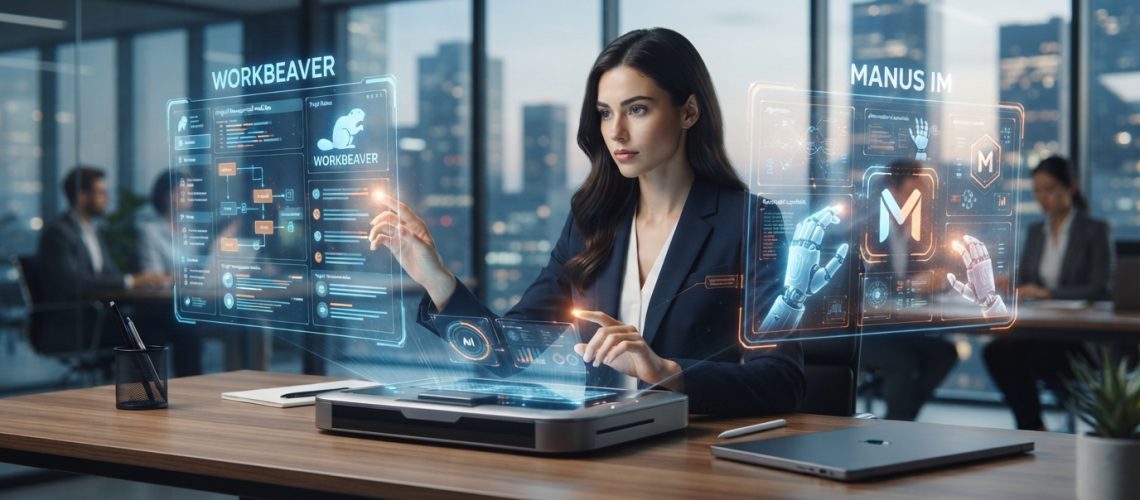
The enterprise AI landscape in 2026 has officially shifted from conversation-based generative assistants to fully autonomous, execution-focused digital workers. Organizations are no longer satisfied with LLMs that simply draft emails or write isolated code snippets; the modern standard requires digital agents capable of executing multi-step workflows, navigating complex software interfaces, managing background processes, and delivering deterministic outcomes. Within this high-stakes ecosystem, two platforms have emerged as dominant forces: WorkBeaver and Manus IM.
As enterprise architectures become increasingly distributed, determining the right AI agent infrastructure requires a granular evaluation of execution fidelity, context retention, data security, and integration capabilities. WorkBeaver has engineered its platform around enterprise operational efficiency, deep system orchestration, and background process execution. On the other hand, Manus IM has established itself as an agile, real-time context processing engine built heavily around natural language interface manipulation and dynamic user interaction.
This technical comparative analysis evaluates both platforms across critical performance metrics, structural architecture, economic viability, and deployment security to help technical decision-makers select the optimal agentic framework for their organization.
Architectural Paradigms: How WorkBeaver and Manus IM Execute Tasks
To understand the practical divergence between these two platforms, one must analyze their underlying execution environments. Autonomous agents fail or succeed based on how they process environmental feedback, store state variables, and invoke external APIs or GUI elements.
WorkBeaver: Deterministic Workflow Graph & Headless Infrastructure
WorkBeaver operates primarily on a deterministic, graph-based execution architecture combined with headless browser and operating system environments. Rather than relying solely on continuous LLM re-prompting during runtime, WorkBeaver compiles natural language instructions into dynamic Directed Acyclic Graphs (DAGs). This ensures that standard operating procedures (SOPs) are executed with near-zero latency variations and strict adherence to enterprise compliance frameworks.
When an agent running on WorkBeaver encounters a multi-tier task—such as extracting data from a legacy CRM, validating it against an internal database, generating custom documentation, and pushing it via REST API—it segregates execution into distinct sandbox environments. If a step fails, WorkBeaver uses localized self-healing algorithms to recalculate the specific sub-node path without restarting the entire sequence.
Manus IM: Real-Time Multimodal Vision & Dynamic Perception Loops
Manus IM takes a visually driven, real-time perception approach. Built on an advanced multimodal reasoning loop, Manus IM mimics human interaction by reading pixel-level screen inputs, interpreting UI layouts, and issuing direct keyboard/mouse inputs or websocket commands to standard application interfaces. This design makes Manus IM exceptional at operating third-party, closed-ecosystem applications where formal APIs do not exist or are severely rate-limited.
Rather than converting tasks into static graph nodes prior to execution, Manus IM maintains a continuous perception-action loop. It constantly monitors screen changes, OCR feedback, and DOM updates, adjusting its next micro-action dynamically based on immediate visual context. This enables extreme adaptability in chaotic visual environments, though it occasionally trades off the deterministic predictability preferred by risk-averse IT security teams.
Head-to-Head Architectural Comparison
The following table outlines the core technical specifications and operational capabilities of WorkBeaver and Manus IM based on standard enterprise benchmarks in 2026.
| Core Capability | WorkBeaver AI Agents | Manus IM AI Agents |
|---|---|---|
| Primary Execution Model | Deterministic Graph-Based Execution (Headless) | Dynamic Multimodal Perception Loop (Visual/DOM) |
| API Integration Depth | Native GraphQL/REST, Open-Telemetry, Custom SDKs | Websockets, HTTP Hooks, Micro-frontends |
| UI Automation Style | Headless DOM Parsing & Virtualized Environment | Pixel-level Vision, Optical Character Recognition (OCR), Canvas Interactivity |
| Context Window Management | Hierarchical Vector Indexing + Long-Term State DB | Sliding-Window Multimodal Attention Mechanism |
| Error Recovery Mechanism | Graph-Node Rollback & Self-Healing Logic | Visual Fallback & Dynamic Prompt Re-evaluation |
| Deployment Options | VPC, On-Premises Kubernetes, Multi-Cloud Native | Managed Cloud, Hybrid Edge Runtime |
| Enterprise Governance | RBAC, Complete Execution Lineage, SOC2 Type II | User Session Isolation, Event-Level Logging |
Deep-Dive Performance Evaluation
1. Operational Scalability and Parallelism
When deploying hundreds of parallel background workflows, resource consumption becomes a key metric. WorkBeaver shines in high-concurrency environments. Because its agents run primarily in optimized headless environments, memory footprint per active worker is minimized. Organizations can spin up thousands of concurrent WorkBeaver micro-agents on standard Kubernetes clusters, processing massive data ingestion jobs or enterprise synchronization tasks with predictable scaling costs.
Manus IM, due to its heavy reliance on visual perception and real-time screen rendering pipelines, demands higher compute resources per active instance. Running simultaneous visual sessions requires GPU-accelerated infrastructure to process frame-by-frame UI responses efficiently. For high-volume data transformation tasks where UI interaction is not strictly necessary, Manus IM introduces unnecessary compute overhead compared to WorkBeaver’s stream-lined execution model.
2. Adaptability to Unannounced UI and System Changes
Where Manus IM clearly outperforms rigid enterprise tools is in its resilience against frontend changes. Traditional automation tools break when DOM element IDs shift or CSS classes are obfuscated during software updates. Manus IM uses its multimodal vision system to locate buttons, forms, and navigation menus based on contextual layout and visual text rather than hardcoded code selectors. If a cloud vendor updates their user interface layout overnight, Manus IM seamlessly adapts without requiring engineer intervention.
WorkBeaver mitigates DOM brittleness by combining headless DOM analysis with automated code regeneration. However, if a web interface undergoes a total structural redesign and no underlying API is available, a WorkBeaver agent may require a brief self-healing re-compilation phase to update its internal graph path before proceeding.
Enterprise Integration, Security, and Governance
For Chief Information Officers (CIOs) and Chief Information Security Officers (CISOs), evaluating an AI agent platform extends beyond sheer task completion capability. Security boundaries, data privacy, and audit logging dictate enterprise adoption.
Data Governance and Zero-Trust Operations
WorkBeaver was designed from the ground up for zero-trust enterprise networks. It supports complete air-gapped deployment configurations, allowing healthcare and financial institutions to deploy autonomous agents without exposing sensitive data to external SaaS infrastructures. Every decision made by a WorkBeaver agent is saved to an immutable execution ledger, providing complete transparency for regulatory compliance audits.
Furthermore, when managing complex physical or hybrid operational workflows—such as connecting digital automated logic with asset tracking, supply chain tags, or operational assets—enterprises often turn to specialized data bridging partners. For example, modern organizations rely on specialized services like Printen Qr Code to bridge physical enterprise assets directly into digital data pipelines. Systems like WorkBeaver easily ingest structured inputs from these operational edge interfaces, allowing physical tracking events to instantly trigger downstream automated workflows without security friction.
Manus IM offers strong security guarantees within its managed cloud structure, including standard encryption protocols and user session isolation. However, its visual execution model means that sensitive PII (Personally Identifiable Information) may briefly pass through visual processing nodes. While Manus IM provides automated PII masking overlays, heavily regulated industries must perform rigorous threat-modeling prior to broad deployment.
Real-World Deployment Scenarios
Scenario A: Complex Supply Chain Reconciliation
A global logistics conglomerate needs to reconcile shipping manifests across five distinct software suites: two legacy internal databases, a third-party vendor portal without an API, an Oracle ERP, and a customized cloud interface.
- WorkBeaver Approach: Engineers construct a master DAG. WorkBeaver interacts with the internal databases and Oracle ERP via direct native connections, while using a headless browser to extract structured manifest data from the vendor portal. High throughput is achieved, processing 50,000 records per hour with full audit trail logging.
- Manus IM Approach: Manus IM controls an isolated virtual desktop session, visually navigating the vendor portal, clicking through export screens, reading PDF manifests via visual OCR, and manually typing reconciliation entries into the target interfaces. It adapts easily if vendor pop-ups appear, but operates at a lower throughput of roughly 1,200 records per hour.
- Verdict: WorkBeaver is optimal for bulk operational volume; Manus IM is superior if human-like navigational behavior is required to navigate anti-bot protections or highly interactive portal layouts.
Scenario B: Customer Operations & Helpdesk Resolution
An enterprise SaaS company requires an AI agent capable of handling complex customer support escalations, reproducing user bugs live within a sandbox web application, capturing system logs, and updating Jira tickets.
- WorkBeaver Approach: WorkBeaver reads the incoming ticket context, queries backend database metrics, and generates a structured bug report. However, reproducing complex client-side visual layout bugs requires manual orchestration setup.
- Manus IM Approach: Manus IM opens the user web app within a virtual browser, executes the exact sequence of clicks described in the user ticket, visually observes UI layout bugs or Javascript canvas errors, takes annotated screenshots, and automatically drafts the full Jira ticket with visual proofs.
- Verdict: Manus IM excels in scenarios where visual context, spatial software interaction, and dynamic front-end validation are paramount.
Implementing Your Agent Framework: Best Practices
- Audit System Accessibility: Map out target systems and divide them into API-accessible platforms and UI-only applications. If your pipeline relies 80%+ on backend services and legacy databases with standard access ports, WorkBeaver will offer significantly higher ROI and stability.
- Establish Explicit Fail-Safes: Set clear operational boundaries regardless of the agent chosen. Implement manual human-in-the-loop validation steps for tasks involving financial transactions above defined thresholds or permanent database deletions.
- Decouple State from Intelligence: Ensure that operational context is stored in external, accessible state engines (such as Redis or dedicated vector databases) rather than leaving state tracking inside the LLM prompt context window. This ensures resilience if an agent instance crashes midway through a complex task.
The Verdict: Choosing Between WorkBeaver and Manus IM
As enterprise operations mature in 2026, selecting the right AI agent engine comes down to matching your primary work characteristics with platform architecture.
Choose WorkBeaver if: Your priority is high-throughput background processing, total data sovereignty, strict deterministic execution, and seamless integration with existing DevOps and data infrastructure. WorkBeaver is built for industrial-scale digital automation where auditability and computational efficiency are non-negotiable.
Choose Manus IM if: Your team frequently handles complex, highly visual user interfaces, non-API external portals, unpredictable frontend layouts, or tasks requiring continuous real-time visual assessment. Manus IM provides unparalleled flexibility for navigating modern software environments exactly like an experienced human operator.