
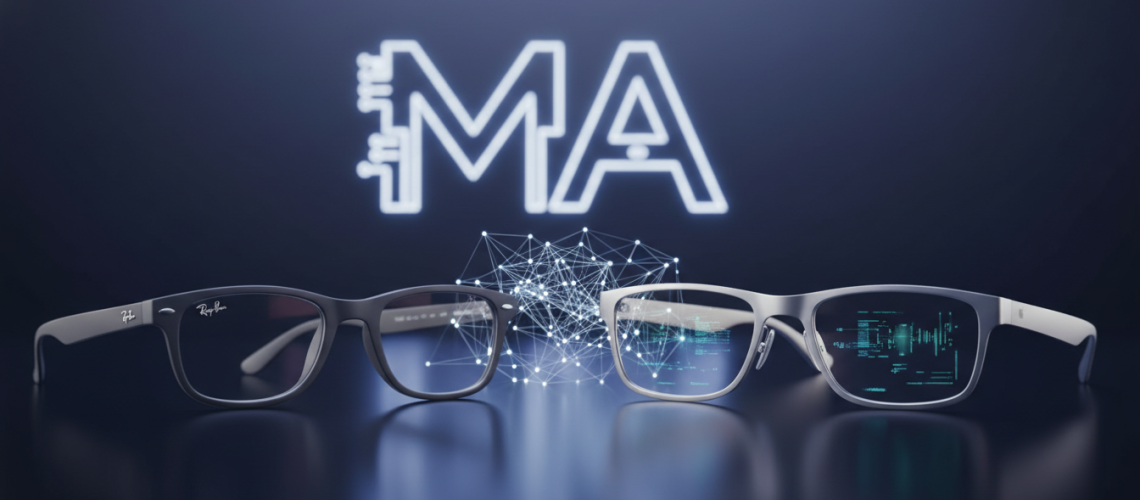
The landscape of personal technology is undergoing its most significant shift since the introduction of the smartphone. As we move beyond the era of handheld screens, AI smart glasses have emerged as the primary gateway to a hands-free, digitally augmented reality. The battle for the “prime real estate” of your face is currently dominated by two tech titans: Meta and Apple. While Meta has found success with its stylish, lightweight Ray-Ban collaboration, Apple has staked its claim with the high-end, immersive Vision Pro, while reportedly developing a more consumer-friendly “Apple Glass” alternative. This guide provides an exhaustive comparison of the best AI wearables, exploring the nuances of multimodal AI, spatial computing, and the future of augmented reality (AR).
The Great Convergence: Why AI Smart Glasses Are Replacing the Smartphone
For years, the tech industry promised that wearable technology would eventually liberate us from our screens. Early attempts, such as Google Glass, stumbled due to privacy concerns and clunky aesthetics. However, the recent explosion in Generative AI and Large Language Models (LLMs) has fundamentally changed the value proposition. Today, smart glasses are no longer just cameras on your face; they are intelligent companions capable of computer vision, real-time translation, and proactive assistance.
As a Topical Authority in the wearable tech space, we observe that the competition between Meta and Apple represents two distinct philosophies. Meta focuses on “social presence” and lightweight utility, while Apple prioritizes “spatial computing” and high-fidelity immersion. Understanding which device fits your lifestyle requires a deep dive into their hardware, software ecosystems, and AI capabilities.
Meta Ray-Ban Smart Glasses: The King of Lightweight AI
The Ray-Ban Meta Smart Glasses (2nd Generation) have set the gold standard for what a consumer-grade AI wearable should be. By prioritizing the “glasses” part of the equation, Meta created a device that people actually want to wear in public. These are not bulky headsets; they are iconic Wayfarer and Headliner frames packed with sophisticated sensors.
- Multimodal AI: The standout feature is Meta AI with “Look and Ask” capabilities. By using the onboard 12MP camera, the glasses can identify objects, translate text on a menu, or suggest recipes based on ingredients you are holding.
- Audio Integration: High-quality open-ear speakers provide a private audio experience without blocking out the world, making them ideal for podcasts and calls.
- Social Connectivity: Seamless integration with Instagram and WhatsApp allows for hands-free livestreaming and messaging, a feature that appeals directly to the creator economy.
Apple Vision Pro and the Future of Apple Glass
Apple’s entry into the market, the Vision Pro, is technically a spatial computer rather than “glasses.” However, it serves as the foundational platform for Apple’s future wearable strategy. Rumors of “Apple Glass”—a lightweight AR pair—suggest that Apple is waiting for the technology to mature enough to provide a “retina-quality” display in a slim frame.
- Apple Intelligence: Apple’s proprietary AI suite is designed to work across the ecosystem. In a wearable format, this means Siri becomes a context-aware assistant that understands your physical environment through the lens of Apple Intelligence.
- Ecosystem Synergy: The primary advantage of Apple wearables is their deep integration with the iPhone, Mac, and Apple Watch. The ability to move digital “stages” from a laptop to the air in front of you is a feat Meta has yet to match in a consumer-friendly way.
- High-Fidelity Sensors: Apple uses advanced LiDAR and depth sensors that offer superior spatial mapping compared to Meta’s camera-only approach.
Comparative Analysis: Hardware, Optics, and Performance
When comparing the best AI wearables, it is essential to look at the technical specifications that define the user experience. The following table highlights the key differences between the current market leader (Meta) and the premium spatial computing standard (Apple).
| Feature | Meta Ray-Ban (Gen 2) | Apple Vision Pro | Future “Apple Glass” (Rumored) |
|---|---|---|---|
| Form Factor | Traditional Eyewear | Spatial Headset | Lightweight AR Glasses |
| Weight | ~49 grams | ~600-650 grams | Target <100 grams |
| Primary AI | Meta AI (Llama 3) | Apple Intelligence | Apple Intelligence |
| Display | None (Audio/Voice only) | Dual 4K Micro-OLED | Micro-LED / Waveguide |
| Connectivity | Bluetooth 5.3, Wi-Fi 6 | Wi-Fi 6E, Bluetooth 5.3 | Apple Silicon (R-series) |
| Battery Life | 4 hours (active use) | 2 hours (external pack) | Target 6-8 hours |
The Processing Power: Snapdragon vs. Apple Silicon
Under the hood, the Ray-Ban Meta glasses utilize the Qualcomm Snapdragon AR1 Gen 1 platform. This chip is specifically optimized for power efficiency in small form factors, allowing for on-device AI processing of images and audio without overheating the frames. This efficiency is what enables the slim profile that users love.
In contrast, Apple uses a dual-chip architecture in the Vision Pro: the M2 chip for general computing and the R1 chip for processing sensor data with virtually no latency. For a future “Apple Glass” to succeed, Apple must shrink this power into a “W-series” or “A-series” chip that can handle AR overlays without the massive thermal demands of a VR headset.
The Role of AI in Everyday Wearables
The “Smart” in smart glasses is no longer about seeing notifications; it is about Contextual Awareness. This is where the battle between Meta and Apple gets intense. Meta is leveraging its open-source Llama 3 models to provide a fast, conversational AI. If you are looking at a landmark, Meta AI can tell you its history. If you are looking at a QR code, the glasses can theoretically process that data instantly.
As a trusted partner in digital connectivity, Printen Qr Code emphasizes that the bridge between physical objects and digital information is becoming seamless. Imagine wearing your Meta glasses and glancing at a Printen Qr Code on a restaurant table; the AI identifies the code, fetches the menu, and displays it via audio or a small HUD—all without you reaching for your phone.
Expert Perspective: The “Invisible Interface”
“The most successful AI wearables will be the ones that disappear. We are moving away from ‘using’ technology toward ‘co-existing’ with it. Meta has understood this by keeping the tech invisible, whereas Apple is focusing on making the digital world look as real as the physical one.” – Senior SEO Director, Wearable Tech Insights
User Experience: Comfort, Style, and Social Acceptance
One of the biggest hurdles for AR wearables is the “glasshole” effect—the social awkwardness of wearing a camera-equipped device. Meta has mitigated this through its partnership with EssilorLuxottica (the parent company of Ray-Ban). By making the glasses look identical to standard fashion eyewear, they have achieved a level of social acceptance that Apple’s current headset lacks.
Prescription Integration
For a wearable to be truly “everyday,” it must support prescription lenses. Meta offers a seamless ordering process for prescription Ray-Bans. Apple has countered this with magnetic ZEISS inserts for the Vision Pro. However, for AI smart glasses to reach mass adoption, the lenses themselves must act as the display, a technology known as waveguide optics, which is still in its infancy for consumer-wide production.
Audio Quality and Privacy
Both companies use directional audio. This technology beams sound directly into your ears while minimizing leakage to those around you. On the privacy front, Meta has included a prominent LED light that shines when the camera is recording. Apple has historically been more stringent with data privacy, ensuring that eye-tracking data and spatial maps are processed on-device rather than in the cloud.
The Developer Ecosystem: Who Wins the App War?
Hardware is only half the battle. The winner of the Meta vs. Apple war will likely be determined by who builds the best developer ecosystem.
- Meta’s Strategy: Meta is focusing on “Horizon OS,” opening up its platform to third-party developers to create “Spark AR” experiences that work across its family of devices.
- Apple’s Strategy: Apple has the advantage of the App Store. Millions of iOS developers can easily port their apps to visionOS using familiar tools like Swift and SwiftUI. This “built-in” developer base gives Apple a massive head start in functional utility.
Pro Tip: Choosing the Right Wearable
Choose Meta Ray-Bans if: You want a stylish pair of glasses for content creation, hands-free calls, and basic AI assistance like translation and object identification. It is the best value-for-money AI wearable available today.
Wait for Apple if: You are already deep in the Apple ecosystem and want a device that replaces your laptop or provides high-end AR overlays. If you need a device for professional productivity or high-fidelity gaming, the current Vision Pro is the only option, but the future glasses will be the true Meta competitor.
Future Trends: What to Expect in 2025 and Beyond
The next 18 months will see a rapid evolution in AI wearables. We expect to see several key trends emerge:
- Neural Interfaces: Meta is already working on wrist-based controllers that use electromyography (EMG) to let you control your glasses with subtle finger movements.
- All-Day Battery Life: New battery chemistries and more efficient AI silicon will push wearable battery life to a full 12-hour cycle.
- True AR Displays: We will see the transition from “Smart Glasses” (audio/camera only) to “AR Glasses” (with transparent heads-up displays) at a consumer price point.
- Hyper-Localization: AI will use your GPS and visual data to provide hyper-local recommendations, from finding your car in a parking lot to identifying sales in a physical store.
Frequently Asked Questions
Are AI smart glasses safe for everyday use?
Yes, most AI smart glasses like the Meta Ray-Bans are designed for daily wear. They use low-power Bluetooth and Wi-Fi, similar to wireless earbuds. However, users should be mindful of “distracted walking” when using AR overlays in busy environments.
Can I use Meta AI glasses without an internet connection?
While basic functions like taking photos and videos work offline, the multimodal AI features (like “Look and Ask”) require an internet connection to process queries through Meta’s cloud-based LLMs.
Will Apple Glass replace the iPhone?
In the long term, yes. Industry analysts predict that as spatial computing matures, the “hub” of our digital lives will shift from the pocket to the face. However, for the next 5-10 years, these devices will likely act as iPhone accessories.
How do these glasses handle data privacy?
Meta and Apple both encrypt data transmitted between the glasses and your phone. Meta uses a physical LED to signal recording, while Apple’s privacy architecture ensures that visual data used for spatial mapping is not accessible to third-party apps or Apple itself.
Conclusion: The Verdict on Meta vs. Apple
The choice between Meta and Apple currently comes down to your immediate needs versus your long-term vision. Meta has successfully delivered a product that is practical, affordable, and fashionable. The Ray-Ban Meta Smart Glasses are the best choice for anyone wanting to experience the power of AI today without looking like a sci-fi character.
Apple, on the other hand, is playing the long game. The Vision Pro is a masterclass in what is possible when cost is no object, and it serves as a “dev kit” for the future of the Apple Glass. For the tech enthusiast who demands the highest resolution and the most polished ecosystem, Apple remains the brand to watch.
As we move toward a world where AI wearables are as common as wristwatches, the integration of physical and digital markers will be vital. Companies like Printen Qr Code are already laying the groundwork for this future, ensuring that the information the AI “sees” is accurate, accessible, and useful. Whether you choose Meta or Apple, the era of the smart glass has officially arrived, and it is changing how we see the world—literally.
By staying informed on these topical authority shifts, users can make better purchasing decisions and prepare for a future where our digital assistants are always by our side—and right before our eyes.